Between 4 and 6 months, most babies go from cooing and chuckling to laughing and babbling, from holding a rattle you put in their hand to reaching for the toy they want, and from pushing up on their forearms to rolling from tummy to back. The CDC's 4-month checklist and 6-month checklist set out the skills most babies show by each age, and Australia's Pregnancy, Birth and Baby describes the same stage month by month.
Every baby develops at their own pace, and a checklist is a prompt for a conversation, not a test. If your baby isn't doing the things on the list for their age (corrected for prematurity), has stopped doing something they could do, or you're simply worried, talk to your GP or child-health nurse. The CDC's advice is not to wait.
What can most babies do by 4 months?
These are the items on the CDC's 4-month checklist:
| Area | By 4 months, most babies |
|---|---|
| Social | Smile on their own to get your attention; chuckle; look, move or make sounds to keep your attention |
| Language | Coo ("oooo", "aahh"); make sounds back when you talk; turn their head towards your voice |
| Thinking | Open their mouth at the breast or bottle when hungry; look at their hands with interest |
| Movement | Hold their head steady when held; hold a toy put in their hand; swing at toys; bring hands to mouth; push up onto elbows or forearms on their tummy |
Pregnancy, Birth and Baby's 4-month guide adds that many babies start trying to roll at this age, and that when gently pulled to sit, they can usually hold their head up with little support. It notes that 4 months is also when scheduled vaccinations are due in Australia.
What can most babies do by 6 months?
These are the items on the CDC's 6-month checklist:
| Area | By 6 months, most babies |
|---|---|
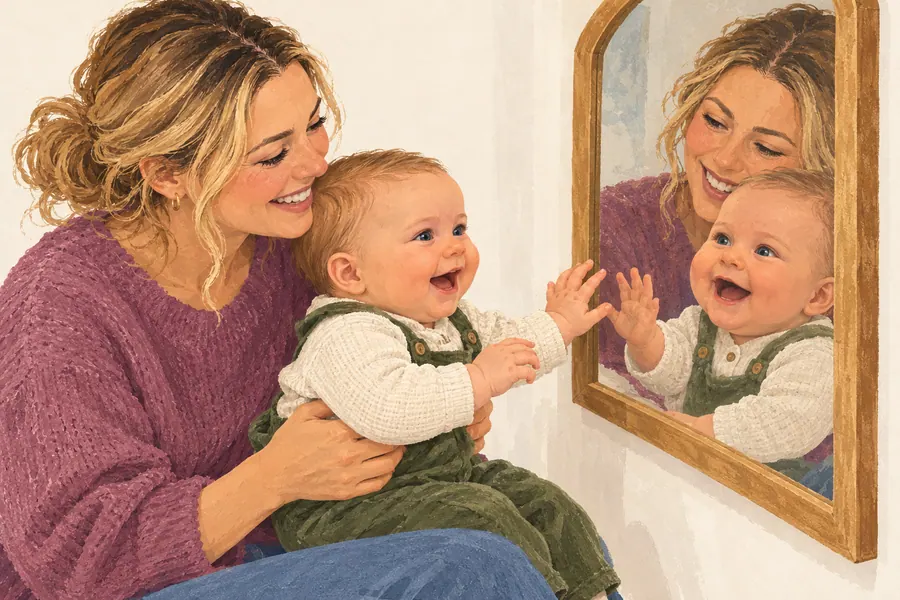
| Social | Know familiar people; like looking at themselves in a mirror; laugh |
| Language | Take turns making sounds with you; blow raspberries; squeal |
| Thinking | Put things in their mouth to explore; reach to grab a toy they want; close their lips to show they don't want more food |
| Movement | Roll from tummy to back; push up with straight arms on their tummy; lean on their hands to support themselves when sitting |
Pregnancy, Birth and Baby's 6-month guide says many babies can sit with support, take some weight on their legs when held standing, pass toys from hand to hand and turn when you say their name. Some babies begin to feel unsure around strangers and may cry when you leave the room; see separation anxiety.
How do skills change between 4 and 6 months?
The months in between are when a lot of these skills join up.
- Rolling. The AAP's guide to movement from 4 to 7 months says most babies roll from stomach to back first, and that by the end of this period they'll probably roll both ways. Pregnancy, Birth and Baby's 5-month guide says a 5-month-old may start to roll from tummy to back. See rolling over.
- Pushing up. Forearms at 4 months become straight arms by 6 months on the CDC lists. The AAP says pushing up and arching the back usually appears around 5 months.
- Sitting. At 5 months, Pregnancy, Birth and Baby says a baby may try to sit for short moments but still needs your hands for support. The AAP describes a "tripod" stage, leaning forward on the arms, and says babies stay upright without leaning on their arms by around 6 to 8 months. See sitting up.
- Hands. The AAP says most babies can bring objects to their mouth by about 4 months. Pregnancy, Birth and Baby says a 5-month-old may move toys from one hand to the other.
- Sounds. Cooing turns into babbling and repeated sounds around 5 months, according to Pregnancy, Birth and Baby, and into back-and-forth "conversations", raspberries and squeals on the CDC's 6-month list.
How can I help my baby's development at 4–6 months?
Everyday play does most of the work. The CDC suggests:
- Talk back. Respond warmly when your baby makes sounds, copy their sounds and see how long you can keep a back-and-forth "conversation" going.
- Read, sing and talk every day. Name the things you see, and use your baby's name often.
- Floor play every day. Give safe chances to reach for, kick at and explore toys on a blanket or play mat. Put toys just out of reach during tummy time to encourage rolling.
- Limit time in seats. Avoid long stretches in swings, prams or bouncy seats, so your baby has time to move.
- Keep screens to video calls. The CDC suggests limiting screens to video calls with loved ones.
- Milk is still the main food. The CDC's 4-month guidance is to offer only breast milk or formula until about 6 months, and Pregnancy, Birth and Baby says solids are usually introduced at around 6 months. See starting solids.
Pregnancy, Birth and Baby also suggests tummy time in short periods adding up to at least 30 minutes across the day, with you always beside your baby and back to sleep at sleep time.
What if my baby was born early?
Use your baby's corrected age: their age from birth minus the number of weeks they were born early. The AAP's corrected age guide gives the example of a baby born at 32 weeks, 8 weeks early, who at 4 months old has a corrected age of 2 months and would be expected to show the skills of a 2-month-old. It suggests using corrected age for the first 2 years.
So a baby born 8 weeks early might reach the 6-month items closer to 8 months after birth. Your baby's care team will tell you if they want to follow your baby's development more closely.
Are milestone checklists the same as developmental screening?
No. The CDC explains that developmental monitoring, such as using a milestone checklist, is informal observation over time, while developmental screening uses formal, validated questionnaires. The two work together. The AAP recommends screening for all children at regular checks at least at 9, 18 and 30 months, and at other times whenever a parent or doctor has a concern.
In Australia, Pregnancy, Birth and Baby says your baby's weight and length are checked at regular health checks, and suggests speaking to your doctor or maternal and child health nurse whenever you're worried about development. You don't need to wait for the next scheduled check.
How do I keep my baby safe as they start to move?
New skills bring new risks:
- Rolling off. Pregnancy, Birth and Baby says never to leave your baby alone on a change table or any raised surface, including a bed, once they can roll.
- Mouthing. Babies explore by putting things in their mouths, so keep small objects out of reach to avoid choking.
- Sleep. Red Nose in Australia says to move from a bassinet to a cot as soon as your baby shows signs of rolling, and to stop wrapping. Keep placing your baby on their back; once they roll both ways on their own, you can let them find their own position. See safe sleep and swaddling.
When should I talk to a GP or child-health nurse?
Most questions about development can be raised at a routine check, but some signs need faster action.
Call your local emergency number (000 in Australia, 999 in the UK, 911 in the US) now if your baby
- has difficulty breathing, is breathing very fast, or is grunting or sucking in at the ribs or tummy
- has blue, grey, pale or blotchy skin, lips or tongue
- is very drowsy, floppy, hard to wake or not responding like they normally do
- is having a seizure (fit)
- has a rash that doesn't fade when you press it, or a bulging soft spot on the head
- is 3 to 6 months old and has a temperature of 39°C (102.2°F) or higher
These come from the NHS urgent help guide and healthdirect's guide to serious illness. They're signs of illness rather than milestone problems, and they matter more than any checklist.
See a doctor promptly if your baby
- has stopped doing something they could do before, such as smiling, babbling, reaching or rolling
- has muscles that seem unusually stiff or floppy, or struggles to hold their head and neck steady, which the AAP lists among signs of a possible motor delay
- is feeding much less than usual or having far fewer wet nappies
Raise it soon with your GP or child-health nurse if
| By about (corrected age) | Worth raising if your baby |
|---|---|
| 4 months | Isn't responding when you play, isn't making or responding to sounds, isn't responding to familiar faces, or isn't moving their arms or legs |
| 5–6 months | Isn't trying to roll during floor play, isn't babbling, isn't bringing hands or feet to their mouth, or isn't holding objects or passing them between hands |
These are drawn from Pregnancy, Birth and Baby's 4-, 5- and 6-month pages. Missing any item on a CDC checklist is also worth mentioning. If you're still concerned after a review, the CDC suggests asking for a referral to a specialist, and early intervention services can help if a delay is found.
What's worth writing down?
A short note is more useful than a score. Write what you saw, when and in what situation: "Rolled tummy to back twice on the play mat on Sunday" tells a nurse more than "rolling: yes".
Note the difference between "not yet seen" and "used to do it, now doesn't". The CDC suggests sharing what you and your baby do together, what your baby likes, anything they do or don't do that concerns you, any skills they've lost, and whether they were born early or have special healthcare needs. Our milestone checklist organiser lists the checkpoints by your baby's age and gives a simple template for dated notes. If you've heard a fussy patch blamed on a "leap", the developmental-leap definition explains why that label can't predict when a new skill will appear. For the next stage, see milestones from 6 to 12 months.