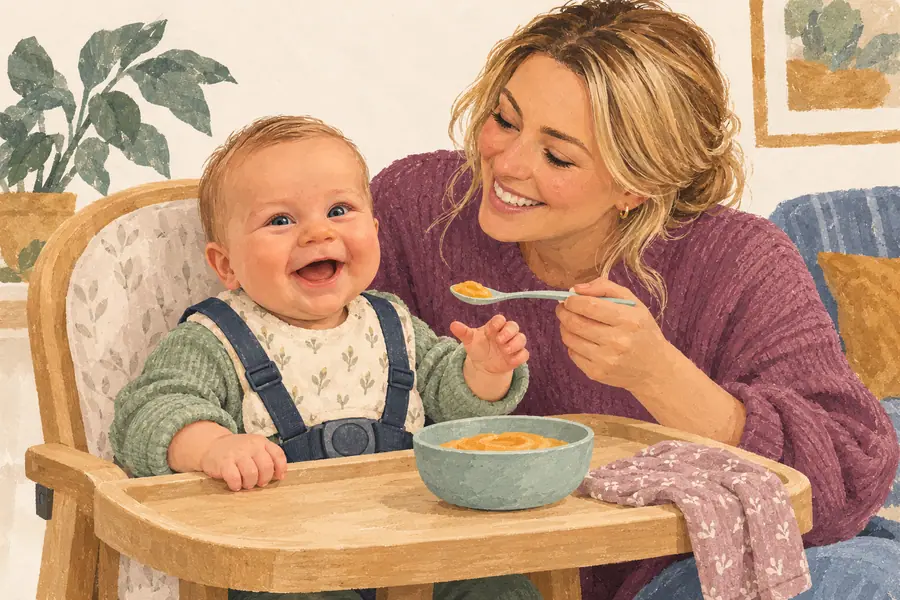
Most babies are ready to start solids at around 6 months. The NHS guide to first solid foods describes three signs that appear together: your baby can sit and hold their head steady, coordinate their eyes, hands and mouth to pick up food, and swallow food rather than spit it back out. Australia's Pregnancy, Birth and Baby and the US CDC both say solids should not start before 4 months.
Start small: Pregnancy, Birth and Baby says 1 to 2 teaspoons of soft, iron-rich food is plenty at first. Meals build gradually over the following months, while breast milk or formula stays your baby's main drink until 12 months. This guide covers readiness, the first meal, what to offer, how much by age, how advice differs between countries, and when to get help. Separate guides go deeper on iron-rich first foods, food textures, baby-led weaning and purées and introducing allergens.
When should my baby start solids?
At around 6 months. The WHO's complementary feeding page explains that at about this age a baby's need for energy and nutrients starts to outstrip what breast milk alone provides. Pregnancy, Birth and Baby adds that iron stores built up before birth are low by 6 months, so babies need more iron, zinc and protein from food. The AAP recommends breast milk only for about the first 6 months.
Waiting until around 6 months gives your baby time to develop the skills to cope with food, according to the NHS. Pregnancy, Birth and Baby explains that until 4 to 6 months, babies have a tongue-thrust reflex that pushes food out, and that solids given too early can cause choking. It also says every baby is different, but all babies benefit from having some solid food by 7 months.
If your baby was born prematurely, the NHS says to ask your health visitor or GP when to start, rather than going by their birth date alone. In Australia, ask your GP or child-health nurse.
What are the signs my baby is ready for solids?
Readiness is about skills, not just age or size. Each source lists slightly different signs:
| Source | Signs it lists |
|---|---|
| NHS (UK) | Sits and holds head steady; coordinates eyes, hands and mouth to pick up food; swallows food rather than spitting it out |
| Pregnancy, Birth and Baby (AU) | Sits upright in a highchair with head and back unsupported; reaches for your food; gets excited about food; opens mouth for a spoon; seems hungry after milk feeds; bites rather than sucks at the breast |
| CDC (US) | Sits up with or without support; controls head and neck; opens mouth when food comes; swallows rather than pushing food out; brings objects to mouth; grasps small objects |
The NHS says three things are often mistaken for readiness: chewing fists, waking more at night, and wanting extra milk feeds. Pregnancy, Birth and Baby includes seeming hungry after milk feeds in its list, so the sources don't fully agree on that one. Look for the physical skills together, around 6 months, rather than relying on hunger alone.
If your baby isn't showing signs of readiness and you're worried, Pregnancy, Birth and Baby suggests talking to your doctor or child-health nurse.
How do I give my baby their first solid food?
- Pick a calm time. Pregnancy, Birth and Baby says there's no best time of day, but offering solids after a mid-morning milk feed means any upset is less likely to disturb night sleep. Your baby shouldn't be too full or too hungry.
- Sit your baby upright and strapped in. The NHS says they need to be sitting safely in an upright position so they can swallow properly.
- Offer a small amount. Start with half a spoonful or less (AAP), or 1 to 2 teaspoons in total (Pregnancy, Birth and Baby). Food should be soft or puréed, or soft finger foods if you're starting with those.
- Let your baby lead. Wait for them to open their mouth, and let them touch and hold food or have a go with the spoon, as the NHS weaning guide suggests.
- Stop when they've had enough. Pregnancy, Birth and Baby says to stop if your baby is full, tired or grumpy, or is turning away, closing their mouth or not swallowing. Never force food.
- Stay with your baby the whole time. The NHS says to always stay with your baby while they eat, in case they start to choke.
Expect faces, spitting out and mess. Pregnancy, Birth and Baby describes eating solids at this stage as being as much about learning as nutrition. The NHS says it can take 10 tries or more for a baby to get used to a new food, flavour or texture.
Should milk come before or after solids?
Pregnancy, Birth and Baby suggests breast milk or formula before solids until 9 months, then after solids. The AAP suggests milk first, then small tastes of food, then more milk. The NHS guide to feeding from around 6 months suggests offering milk after solids, because a baby's stomach fills up quickly. Choose what suits your baby; the important part is that milk stays their main drink.
What foods should I start with?
Pregnancy, Birth and Baby says foods can be introduced in any order, as long as they're iron-rich, and lists these first foods:
- iron-enriched infant cereal
- puréed red or white meat, including fish
- cooked plain tofu
- cooked legumes such as lentils
- puréed fruit and vegetables
The NHS suggests starting with less sweet vegetables such as broccoli, cauliflower and spinach, and says babies don't need baby rice. The AAP says first foods are your choice, and the CDC suggests choosing iron-fortified oat, barley or multigrain cereals rather than only rice cereal. First foods and iron explains how to prepare iron-rich foods.
Common allergy foods such as egg, peanut, wheat, dairy and fish can be introduced as part of these first foods. Pregnancy, Birth and Baby says to start them before 12 months, and the NHS says to introduce them one at a time and in small amounts so you can spot a reaction. The CDC suggests one single-ingredient food at a time, waiting 3 to 5 days between new foods, and says to talk to your child's doctor first about peanut if your baby has severe eczema or an egg allergy. Introducing allergens has the full plan.
Some foods aren't suitable in the first year, including honey, whole nuts, added salt and sugar, and cow's milk as a main drink. See foods to avoid.
How much solid food does a baby need by age?
| Age | Meals a day | What the guidance says |
|---|---|---|
| Around 6 months | Start with once a day | 1–2 teaspoons is plenty at first (PBB) |
| 6–8 months | 2–3 (WHO) | Offer more meals once your baby eats 2–3 tablespoons at a time (PBB) |
| 7–9 months | Moving towards 3 (NHS) | About 4 milk feeds a day alongside (NHS) |
| 9–12 months | 3–4 (WHO) | By 10–12 months, 3 meals and about 3 milk feeds (NHS) |
| From 12 months | 3 meals plus 2 snacks (NHS) | Mostly family foods (PBB) |
PBB is Australia's Pregnancy, Birth and Baby. The NHS says babies under 12 months don't need snacks; if they seem hungry between meals, offer an extra milk feed. The baby feeding schedule by age has example days that show how milk and meals fit together.
Amounts vary a lot from meal to meal and day to day. The NHS says to let your baby decide how much to eat, and the WHO describes good complementary feeding as following a child's hunger and fullness signals.
How do I keep my baby safe while they learn to eat?
- Always supervise. Pregnancy, Birth and Baby says small, hard foods are a choking hazard, but babies can choke on food of any texture.
- Sit upright, every meal. The CDC's choking guide says not to let children eat lying down, crawling or walking, or in a car or pram.
- Prepare food to a safe texture. Avoid hard foods such as whole nuts or raw carrot and apple, and quarter small round foods like grapes, as the NHS advises. Food textures explains how to progress safely.
- Know gagging from choking. The NHS says gagging is common when solids start: your baby's eyes may water, they may push their tongue forward and they may retch. Choking is when they can't cough effectively, cry or breathe. See choking vs gagging.
- Handle food safely. Pregnancy, Birth and Baby says never to reheat food more than once, or food that has been at room temperature for more than 2 hours.
These steps follow the NHS choking first-aid guide, which also says to get medical help afterwards even if the food came out. An infant first-aid course before you start solids is worth the time.
How does solids advice differ between countries?
| Topic | Australia (PBB) | UK (NHS) | US (CDC, AAP) |
|---|---|---|---|
| When to start | Around 6 months, not before 4 | Around 6 months | About 6 months, not before 4 |
| First foods | Iron-rich, in any order | Vegetables, finger foods early; baby rice not needed | Your choice; include iron-fortified cereal |
| Milk and food | Milk before solids until 9 months | Milk after solids | Milk, then food, then milk |
| New foods | Allergy foods before 12 months | Allergy foods one at a time | One new food every 3 to 5 days |
None of these is wrong, and they share the big points: around 6 months, iron-rich foods, small amounts, your baby setting the pace, and milk as the main drink until 12 months. Follow the advice of your own GP or child-health nurse if it differs. Water from a cup with meals is covered in water for babies.
When should I get help?
Call your local emergency number (000 in Australia, 999 in the UK, 911 in the US) now if your baby:
- is choking and can't cough, cry or breathe, or becomes unresponsive
- has swollen lips, tongue or throat with difficulty swallowing, or is struggling to breathe or breathing very fast
- has blue, grey, pale or blotchy skin, lips or tongue
These emergency signs come from the NHS guide to spotting a seriously ill baby. If your baby has hives, facial swelling or vomiting after a new food, follow the steps in introducing allergens.
Talk to your GP or child-health nurse if:
- your baby was born prematurely and you're not sure when to start
- your baby shows no signs of readiness at around 6 months and you're worried
- your baby isn't having any solid food by about 7 months
- meals are consistently distressing, or your baby has severe eczema or a known food allergy before you introduce allergy foods
What's worth noting in the first weeks?
A short note of each new food, how it was prepared and how your baby responded helps you spot patterns, such as a texture they're not ready for or a food that might have caused a reaction. It also makes it easy to see which iron-rich foods and common allergy foods you've already offered. Record what happened rather than how much was eaten; small amounts are normal at this stage.