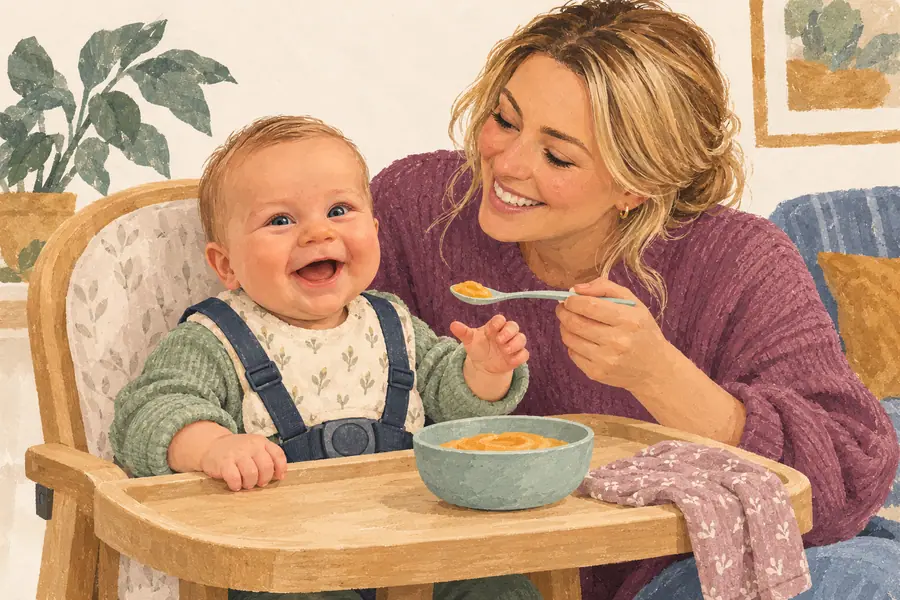
Baby-led weaning and spoon-feeding are two ways of introducing the same foods. The NHS guide to first solid foods describes baby-led weaning as giving your baby only finger foods and letting them feed themselves from the start, instead of feeding them puréed or mashed food on a spoon. It says there's no right or wrong way, many parents combine the two, and the most important thing is that your baby eats a wide variety of food and gets the nutrients they need.
On safety, the NHS says there's no more risk of choking when a baby feeds themselves than when they're fed with a spoon. The rules that keep meals safe are the same either way: start at around 6 months, prepare food to a texture your baby can manage, include iron-rich foods, and keep your baby upright with an adult beside them. This guide compares the approaches, explains how to do each one well, and shows how to mix them.
What is baby-led weaning, and what is spoon-feeding?
Baby-led weaning means offering soft finger foods your baby can pick up, from the very first meal, and letting them decide what goes in their mouth and how much. Australia's Pregnancy, Birth and Baby describes it as offering small amounts of food on a tray or plate for your baby to pick up, and says the food still needs to be soft enough to eat.
Spoon-feeding (often called the purée approach) starts with smooth or mashed food offered on a spoon, then moves towards lumps and finger foods. Pregnancy, Birth and Baby starts with smooth purées, and the AAP says first foods should be soft or puréed.
Most families end up somewhere in between. Pregnancy, Birth and Baby says you don't have to stick to one way, and that a baby can be given food on a spoon as well as food to pick up.
How do baby-led weaning and purées compare?
| Question | Baby-led weaning | Spoon-feeding |
|---|---|---|
| Who puts food in the mouth? | Your baby, from the start | You, with a spoon; your baby can have a go |
| First textures | Soft finger foods that break up easily | Smooth or mashed food |
| Iron-rich foods | Soft meat, boneless fish, egg, soft lentils | Fortified cereal, puréed meat, mashed legumes |
| Choking risk | No more than spoon-feeding (NHS) | Same safety rules apply |
| What comes next | More variety and family foods | Lumps and finger foods over the following months |
Neither column is a complete safety checklist. Both depend on your baby being ready at around 6 months; see starting solids for the readiness signs.
Either way, expect mess. The NHS weaning guide suggests easy-to-clean bibs and a mat under the high chair.
Is baby-led weaning safe?
It can be, when the conditions are right. The NHS statement that self-feeding carries no more choking risk than spoon-feeding sits alongside its other advice: offer finger foods that break up easily in the mouth, avoid hard foods such as whole nuts or raw carrot and apple, and always stay with your baby while they eat. Pregnancy, Birth and Baby adds that babies can choke on food of any texture.
To keep self-feeding safe:
- Sit your baby upright and strapped in for every meal. The CDC's choking guide says not to let children eat lying down, crawling or walking, or in the car or pram.
- Let your baby feed themselves, as the NHS describes for baby-led weaning, rather than placing pieces in their mouth.
- Prepare food safely. Cook hard vegetables and fruit until soft, quarter small round foods like grapes, remove bones, pips and stones, and never give whole nuts. The CDC also lists chunks of nut butter, whole beans and tough meat as hazards.
- Know what gagging looks like. The NHS says a gagging baby's eyes may water, they may push their tongue forward and they may retch. It's common while learning; see choking vs gagging.
These steps follow the NHS choking first-aid guide. Whichever method you use, an infant first-aid course before you start is worth doing.
How do I start baby-led weaning, step by step?
- Check readiness. Your baby should be able to sit with a steady head, pick up food and bring it to their mouth, and swallow it, as the NHS describes. The AAP suggests finger foods once a baby can sit up and bring their hands or objects to their mouth.
- Choose soft, grabbable foods. The NHS says pieces about the size of your own finger work well, big enough to hold in a fist with a bit sticking out. It suggests soft cooked vegetables, slices of soft fruit such as banana, pieces of avocado, cooked pasta or potato, boiled egg, beans and lentils, and boneless fish or meat.
- Include iron at most meals. Pregnancy, Birth and Baby says first foods should be iron-rich; for self-feeding, that means soft strips of tender meat, flaked fish, egg, or mashed lentils your baby can scoop with their hands. See first foods and iron.
- Put a few pieces on the tray and let your baby explore. They may only squash or lick food at first.
- Let your baby set the pace and amount. The NHS guide to feeding from around 6 months says to let your baby eat as much or as little as they want.
- Keep milk feeds going. Breast milk or first infant formula is still the main source of nutrition at this age, according to the NHS.
How do I spoon-feed responsively?
Spoon-feeding works well when your baby still leads. The AAP suggests starting with half a spoonful or less and stopping if your baby cries or turns away, then going back to milk for a while. Wait for your baby to open their mouth rather than pushing the spoon in. The NHS suggests letting your baby have a go with the spoon themselves, and offering finger foods alongside.
The main risk with spoon-feeding is staying on smooth purées too long. The NHS suggests moving on to mashed and finger foods as soon as your baby is ready, and offering lumpy textures from around 6 to 7 months. Pregnancy, Birth and Baby says lumpy food should be introduced by 9 months to lower the chance of feeding problems later. Food textures shows how to progress.
Can I combine baby-led weaning and purées?
Yes, and many families do. A combined meal might pair a spoonful of something mashed with a few soft finger foods your baby can grab.
Example day at about 7 months — adjust to your baby
| Meal | What's offered |
|---|---|
| Breakfast | Iron-fortified cereal on a preloaded spoon for your baby to hold, plus soft pear slices |
| Lunch | Mashed lentils on a spoon, plus soft cooked broccoli florets |
| Dinner | Minced beef stirred through mashed sweet potato, plus soft sweet potato wedges |
This is a made-up example, not a target. Milk feeds continue around the meals, and the NHS says babies under 12 months don't need snacks. Common allergy foods such as egg and peanut fit into either approach; see introducing allergens.
Which approach is right for my baby?
The WHO's complementary feeding page focuses on what matters for any method: foods that give enough energy and nutrients, prepared safely, offered in response to your baby's hunger and fullness, with texture advancing as your baby grows. Within that, choose what suits your baby and your family. Things worth weighing:
- Your baby's skills. The AAP suggests finger foods once a baby can sit up and bring their hands to their mouth, so if those skills are still developing, a spoon alongside finger foods can help.
- Iron. With either approach, check that iron-rich foods are part of most meals.
- Your confidence. If gagging worries you, a combined approach and a first-aid course can help.
- Other carers. Make sure anyone feeding your baby knows how you prepare food and what to do in an emergency.
If your baby was premature, has a developmental or medical condition affecting feeding, or has had trouble with milk feeds, talk to your GP or child-health nurse before choosing.
When should I get help?
Call your local emergency number (000 in Australia, 999 in the UK, 911 in the US) now if your baby is choking and can't cough, cry or breathe, turns blue or becomes unresponsive.
Talk to your GP or child-health nurse if your baby still can't manage lumps or finger foods by around 9 months, meals are consistently distressing, your baby gags and vomits at most meals, or you're worried they aren't eating enough or growing well. Note what was offered, how it was prepared and how your baby managed, so they can see the pattern.