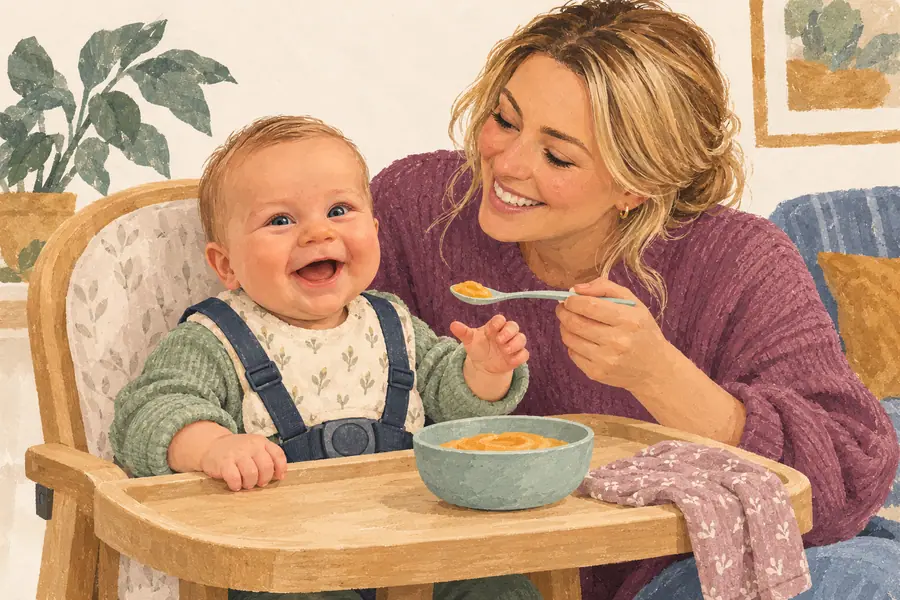
Food textures move from smooth or mashed at around 6 months, through lumps and soft finger foods, to chopped family food by about 12 months. The NHS guide to feeding from around 6 months suggests moving on to mashed and finger foods as soon as your baby is ready and offering lumpy textures from around 6 to 7 months. Australia's Pregnancy, Birth and Baby says most babies can manage finger foods at about 8 months, and that lumpy food should be introduced by 9 months to lower the chance of feeding problems later.
Every baby moves at their own pace, but the direction is the same: a little more texture every few weeks, with your baby sitting upright and an adult right beside them. This guide sets out what each stage looks like, how to prepare food safely, how to tell gagging from choking, and what to do in an emergency. If your baby hasn't started solids yet, begin with starting solids.
How should baby food textures progress by age?
| Age | UK (NHS) | Australia (PBB) | WHO |
|---|---|---|---|
| Around 6 months | Mashed and soft finger foods; may not need smooth purées at all | Smooth, easy-to-swallow purées, moving on to minced and chopped | Puréed, mashed and semi-solid foods |
| 6–9 months | Lumps from around 6 to 7 months; mashed, lumpy and finger foods as soon as they can manage | Finger foods at about 8 months; lumpy food by 9 months | Most manage finger foods by about 8 months |
| 10–12 months | Mashed, lumpy, chopped and finger foods; bigger chunks of soft food | Moving towards family foods | Texture keeps advancing with age |
| From 12 months | 3 meals plus 2 snacks a day | A wide variety of family foods | Nutrient-dense foods, including meat, fish, eggs and dairy |
PBB is Australia's Pregnancy, Birth and Baby. The UK column draws on the NHS pages for 6 months, 7 to 9 months and 10 to 12 months, and the NHS weaning guide, which says babies may not need smooth, blended foods at all. The WHO column comes from the WHO's complementary feeding page.
The sources differ mainly on how fast to move. The NHS encourages lumps and finger foods early, while Australian guidance starts smooth and sets 9 months as the point to have lumps in place. Both agree that staying on smooth purées for too long isn't the aim.
Why do textures matter for babies?
Learning to manage lumps is a skill, not just a preference. The NHS says babies take different amounts of time to get used to lumps, "but it's an important skill they need to learn". Pregnancy, Birth and Baby explains that chewing helps jaw and speech development, and that offering a range of textures gives your baby the chance to explore and try food.
Babies don't need teeth for this stage. Pregnancy, Birth and Baby notes that young babies use their gums to "chew" soft food. Finger foods also help: the NHS says they get babies used to different textures and help them learn to feed themselves.
How do I prepare each texture?
| Texture | What it looks like | How to make it |
|---|---|---|
| Smooth or puréed | No lumps; drops off a spoon | Cook vegetables to soften, then blend; blend soft ripe fruit |
| Mashed | Soft with small, soft lumps | Mash cooked vegetables, starchy foods or ripe fruit with a fork |
| Lumpy or minced | Bigger soft pieces mixed through | Mash less, or chop cooked food finely |
| Soft finger foods | Pieces your baby can hold | Finger-sized and soft enough to break up easily in the mouth |
| Chopped family food | Small pieces of the family meal | Cut up and served without added salt |
The cooking and mashing steps come from the NHS. Its first solid foods guide says finger food pieces about the size of your own finger work well, big enough to hold in a fist with a bit sticking out, and that first finger foods should break up easily in the mouth. It suggests:
- soft cooked vegetables such as carrot, broccoli, cauliflower, parsnip and butternut squash (pumpkin)
- slices of soft fruit such as peach, melon and banana, or apple and pear cooked until soft
- grabbable pieces of avocado
- cooked starchy foods such as potato, sweet potato, pasta, noodles and rice
- beans and lentils, fish without bones, meat without bones, and boiled eggs
- sticks of pasteurised full-fat hard cheese
Cook eggs until the white and yolk are firm unless you're in the UK using British Lion-stamped eggs, which the NHS says can be eaten raw or lightly cooked; Australian guidance lists raw egg as unsuitable. Let cooked food cool right down before serving, as the NHS advises.
Which foods and textures are choking risks?
Some foods need changing, not just cutting smaller. The CDC's choking hazards list includes:
- Hard raw fruit and vegetables, such as raw carrot or apple. The CDC's solids guide suggests cooking them until they can be mashed.
- Small round foods, such as grapes, cherry tomatoes, berries and cherries. The NHS says to cut small round foods into quarters.
- Whole or chopped nuts and seeds, and chunks or spoonfuls of nut butter. Offer smooth nut butter spread thinly or stirred into food instead.
- Sausages and hot dogs. The CDC suggests cutting cylindrical foods into short, thin strips.
- Tough or large chunks of meat or cheese, bones in meat or fish, and whole beans.
- Popcorn, chips, hard or sticky lollies, marshmallows and chewing gum.
The CDC also says to keep your child sitting upright while eating, never lying down, crawling or walking, and not in the car or pram. Pregnancy, Birth and Baby reminds parents that babies can choke on food of any texture, so stay with your baby every time. Foods to avoid covers other foods that aren't suitable in the first year.
Is it normal for my baby to gag on lumps?
Yes. The NHS says your baby may gag when you introduce solid foods, and describes the signs: their eyes may water, they may push their tongue forward or out, and they may retch to bring food forward or vomit. Gagging is noisy, and your baby can still breathe.
If your baby gags a lot or refuses lumps:
- Keep offering. The NHS says it can take 10 tries or more for a baby to get used to new foods, flavours and textures.
- Mix old and new. Offer a lumpier version alongside a texture your baby already manages.
- Let them feed themselves. Soft finger foods let your baby control how much goes in.
- Eat together. Pregnancy, Birth and Baby says babies learn to eat by watching other people.
- Stay calm and don't force it. Pregnancy, Birth and Baby says to stop if your baby turns away, closes their mouth or isn't swallowing.
Choking vs gagging explains the difference in more detail.
What should I do if my baby is choking?
Choking is different from gagging: your baby's cough is silent or weak and they can't cry or breathe properly. Follow the NHS choking first-aid steps for a baby under 1:
- If your baby is coughing loudly, encourage them to keep coughing and stay with them.
- If the cough is silent or they can't breathe, shout for help and have someone call your local emergency number (000 in Australia, 999 in the UK, 911 in the US).
- Give up to 5 back blows with your baby face down along your thigh and their head supported, checking after each one.
- If that doesn't work, give up to 5 chest thrusts, checking after each one.
- Call your local emergency number (000 in Australia, 999 in the UK, 911 in the US) if the blockage hasn't come out, and keep repeating back blows and chest thrusts until help arrives.
- If your baby becomes unresponsive, put them on a firm, flat surface, call your local emergency number (000 in Australia, 999 in the UK, 911 in the US) on speaker and remove the object only if you can clearly see it and easily grasp it. If they aren't breathing normally, start CPR and follow the call-taker's instructions. If they are breathing normally, turn them on their side with their head slightly tilted back, stay with them and keep checking their breathing.
- Get medical help afterwards, even if the food came out, because part of it may still be there or your baby may have been hurt.
An infant first-aid and CPR course before you start solids is worth doing; it's much easier to act when you've practised.
When should I get help?
Call your local emergency number (000 in Australia, 999 in the UK, 911 in the US) now if your baby is choking and can't cough, cry or breathe, turns blue or becomes unresponsive.
Talk to your GP or child-health nurse if:
- your baby still can't manage any lumps by around 9 months, the age by which Australian guidance says lumps should be introduced
- meals are regularly distressing, or your baby gags and vomits at most meals
- your baby coughs or splutters during most meals, or you have any worries about chewing or swallowing
- your baby was premature or has a condition that affects feeding and you'd like a plan for textures
What's worth noting as textures change?
A quick note of each texture you've tried, how it was prepared and how your baby managed it shows progress that's easy to miss day to day. It also helps when another carer feeds your baby: "mashed with a fork, small soft lumps" is far clearer than a stage number on a jar.