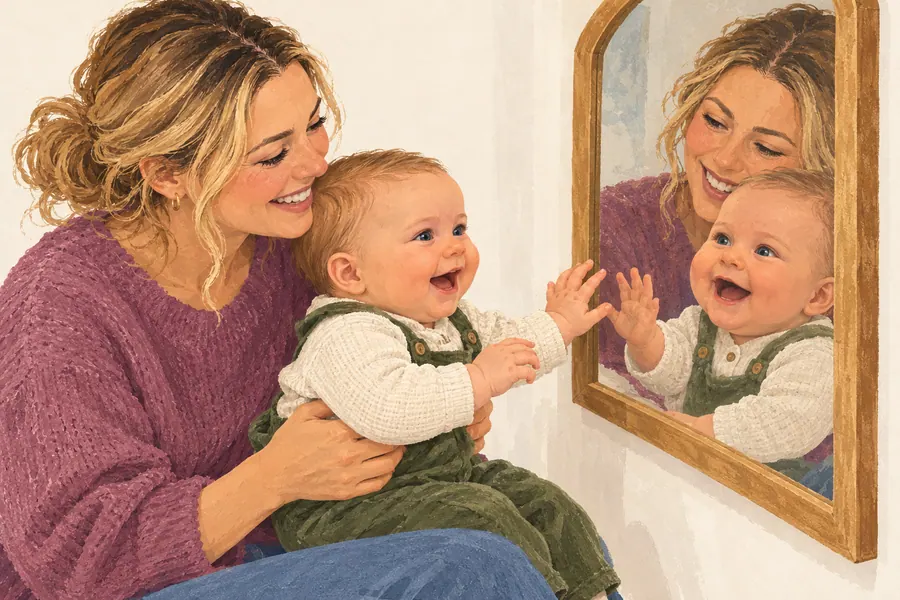
In the first three months your baby moves from mostly reflex movements to smiling back at you, cooing and lifting their head during tummy time. The CDC's 2-month milestone checklist describes skills that most babies (75% or more) can do by 2 months, including smiling when you talk to them, looking at your face, making sounds other than crying, reacting to loud sounds and holding their head up when on their tummy. Because three-quarters of babies have these skills by that age, many start earlier and some take a little longer.
The checklist is not a test. If something is missing, has been lost, or you simply have a feeling that something isn't right, the CDC's advice is not to wait: talk to your child's doctor and ask about developmental screening. In Australia that conversation can be with your GP or child-health nurse.
What can most babies do by 2 months?
These are the CDC's 2-month milestones, grouped the way the checklist groups them. Read it as a picture of a typical 2-month-old, not a pass mark.
| Area | What most babies do by 2 months |
|---|---|
| Social and emotional | Calm down when spoken to or picked up; look at your face; seem happy to see you; smile when you talk to or smile at them |
| Language | Make sounds other than crying; react to loud sounds |
| Thinking and learning | Watch you as you move; look at a toy for several seconds |
| Movement | Hold their head up when on their tummy; move both arms and both legs; open their hands briefly |
The CDC's online checklist adds two practical rules. If your baby's age falls between two checklist ages, use the checklist for the younger age. If your baby was born more than 3 weeks early, use their corrected age.
How does a baby develop from birth to 3 months?
Development in these weeks is fast, and it builds on itself. This table brings together what Australian and US sources describe at each stage.
| Age | What you might notice |
|---|---|
| About 1 month | Mostly reflexes: sucking, turning towards a touch on the cheek, gripping your finger, startling at sudden noises. Hands usually in fists. May briefly lift and turn their head on their tummy |
| About 2 months | Lifts head for short moments during tummy time, waves arms and legs, hands more open. Smiles back, makes eye contact, coos or gurgles when content |
| About 3 months | Lifts head during tummy time and may lift the chest a little, brings hands together, reaches and mouths objects, recognises your voice and turns to look for you |
| By about 4 months (CDC) | Coos ("oooo", "aahh"), chuckles, turns towards your voice, holds head steady when held, pushes up onto forearms on tummy, holds a toy put in their hand |
The first three rows come from Pregnancy, Birth and Baby's month-by-month pages for 1 month, 2 months and 3 months, an Australian Government service. The last row is from the CDC's 4-month checklist. Our 4–6 month milestones guide picks up from there.
At 1 month your baby can't see clearly yet and may sometimes look cross-eyed, and they will start looking at faces. By 3 months many babies are more settled and alert, though crying is still their main way of telling you they need something.
When do babies start smiling and cooing?
Smiling when you talk to or smile at them is on the CDC's 2-month list, and Pregnancy, Birth and Baby describes 2-month-olds smiling back and making eye contact. So by about 2 months most babies are giving you real, responsive smiles, and many start earlier. Cooing or gurgling when calm also tends to appear around 2 months and grows over the next few weeks.
By 4 months the CDC lists making "oooo" and "aahh" sounds, making sounds back when you talk, and turning towards your voice. These early back-and-forth exchanges are the start of conversation. Our first words guide follows the whole path from cooing to talking.
How can I help my baby's development from 0 to 3 months?
You don't need special toys or programs. The CDC and Pregnancy, Birth and Baby suggest everyday things:
- Respond to your baby. When they make sounds, smile, act excited and talk back. Copy their sounds and see how long your "conversation" lasts.
- Talk, read and sing during feeds, nappy changes and baths. Your voice is what your baby wants to hear.
- Get face to face. Babies prefer faces. Look at bright pictures or faces together and talk about them.
- Follow the sound. Shake a rattle to one side of your baby's head and see if they look for the noise.
- Cuddle and hold your baby. Comfort helps them feel safe, and responding to their signals helps them learn to settle with your support. See soothing a crying baby.
- Offer tummy time while your baby is awake and you're watching (below).
The CDC also suggests limiting your own screen use when you're with your baby so you can respond more easily, and keeping screens for babies to video calls with loved ones.
Tummy time
Tummy time builds the strength your baby needs to lift their head, push up, roll and later crawl. The AAP's tummy time advice is to start from the day you come home, with 3 to 5 minutes 2 to 3 times a day, building gradually towards 15 to 30 minutes a day by 7 weeks. Pregnancy, Birth and Baby suggests a few minutes at a time, adding up to at least 30 minutes across the day. Both agree it should only happen when your baby is awake and you are with them. Our tummy time guide has positions to try if your baby protests.
Read our safe sleep guide for the full checklist.
What if my baby was born early?
The CDC advises using your baby's corrected age if they were born more than 3 weeks early. The AAP explains how to work it out: take your baby's age in weeks and subtract the number of weeks they were born early (40 minus their gestation at birth). A baby born at 32 weeks is 8 weeks early, so at 16 weeks old they are compared with a 2-month-old, not a 4-month-old.
The AAP says using corrected age during the first 2 years gives a better idea of when to expect common milestones. The AAP notes that parents are often frustrated when family and friends compare by birth date, when the baby is actually on track for their corrected age.
Is my baby's development within the normal range?
Every baby develops at their own pace, and Pregnancy, Birth and Baby says it isn't helpful to compare your baby with others. What matters is steady progress over weeks, not any single day.
Because the CDC's milestones are skills 75% or more of babies have by that age, "not yet" a week before the 2-month mark is common. What is not a wait-and-see situation is a baby who stops doing something they could do before, or a baby whose muscles seem unusually stiff or floppy. The AAP lists both as reasons to speak up.
When should I talk to a GP or child-health nurse about development?
Most worries about early development are discussed at a routine check. Pregnancy, Birth and Baby notes that babies need a full health check at 6 to 8 weeks, and that is a good moment to raise questions. Some signs need faster action.
Call your local emergency number (000 in Australia, 999 in the UK, 911 in the US) now if your baby
- has difficulty breathing, is breathing very fast, or is grunting or sucking in at the ribs or tummy
- has blue, grey, pale or blotchy skin, lips or tongue
- is very drowsy, hard to wake, floppy or not responding like they normally do
- is having a seizure (fit)
- is under 3 months and has a temperature of 38°C (100.4°F) or higher
- has not had a wee in 12 hours
These signs come from the NHS urgent help guide for under-5s and healthdirect. They are illness signs rather than milestone problems, but they matter more than any checklist.
See a doctor promptly if your baby
- is feeding much less than usual or having far fewer wet nappies (see a doctor the same day; healthdirect lists refusing to drink and fewer than half the usual wet nappies as signs of dehydration risk)
- has stopped doing something they could do before, such as smiling or making sounds
- has muscles that seem unusually stiff or floppy
Mention it soon, without waiting for the next routine check, if your baby
- isn't smiling at you or responding when you play together
- doesn't react to loud sounds
- isn't moving their arms or legs
- cries a lot or is very hard to settle
- isn't lifting their head at all during tummy time by around 2 months (corrected)
Pregnancy, Birth and Baby lists most of these for 2- and 3-month-olds. Your GP or child-health nurse can check your baby and, if needed, refer them to a specialist for further assessment.
What's worth writing down?
Jot down the date you first notice a new skill, along with anything that worries you and when it happens. If your baby seems to have stopped doing something, note when you last saw it. A few dated notes help a GP or child-health nurse see the pattern over time, and they make a lovely record too.