Label each detail by how you know it: observed, estimated or not recorded. Keep gaps visible, and check which days or caregivers contributed before comparing totals. A complete-looking chart can be less useful than a short record that shows its limits.
Original template · Practical example · Visual guide
Try a worked example
The same week, with missing records
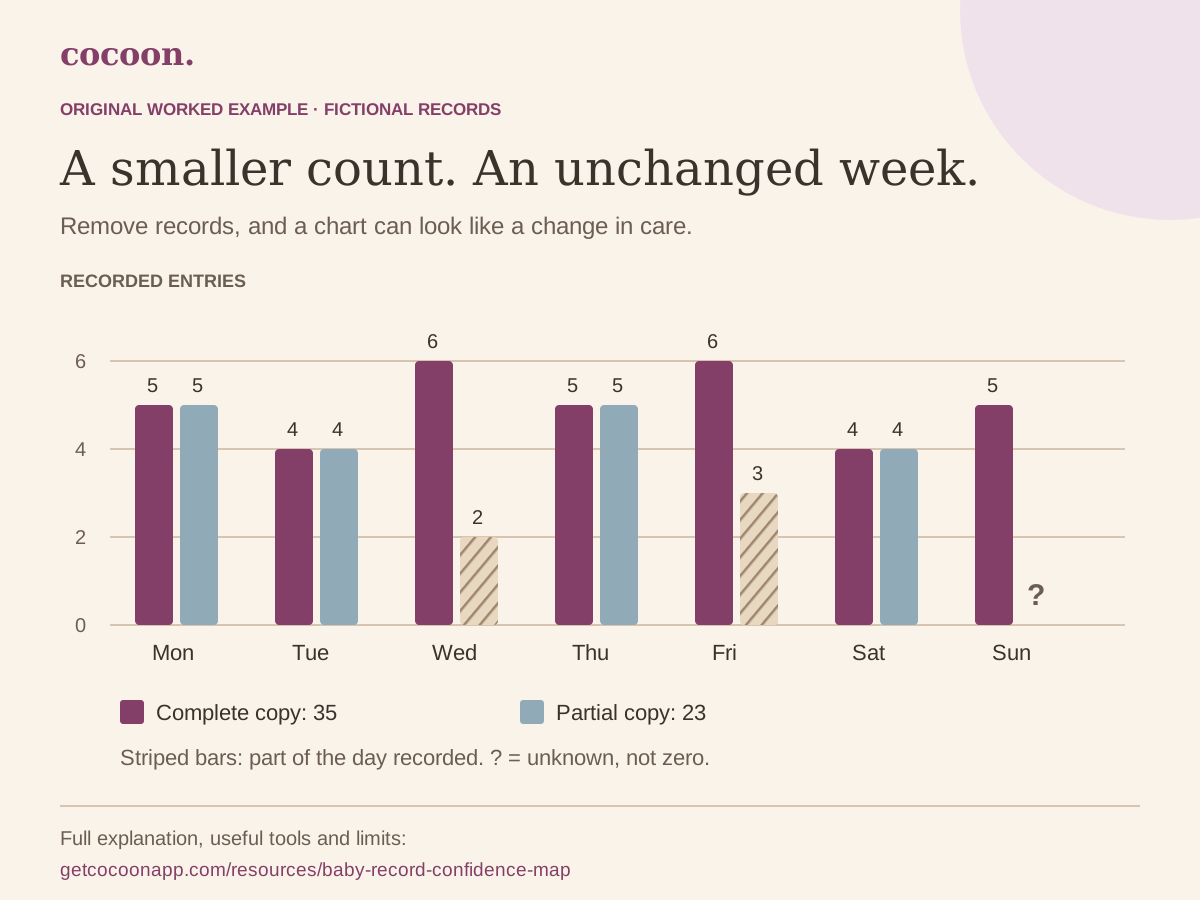
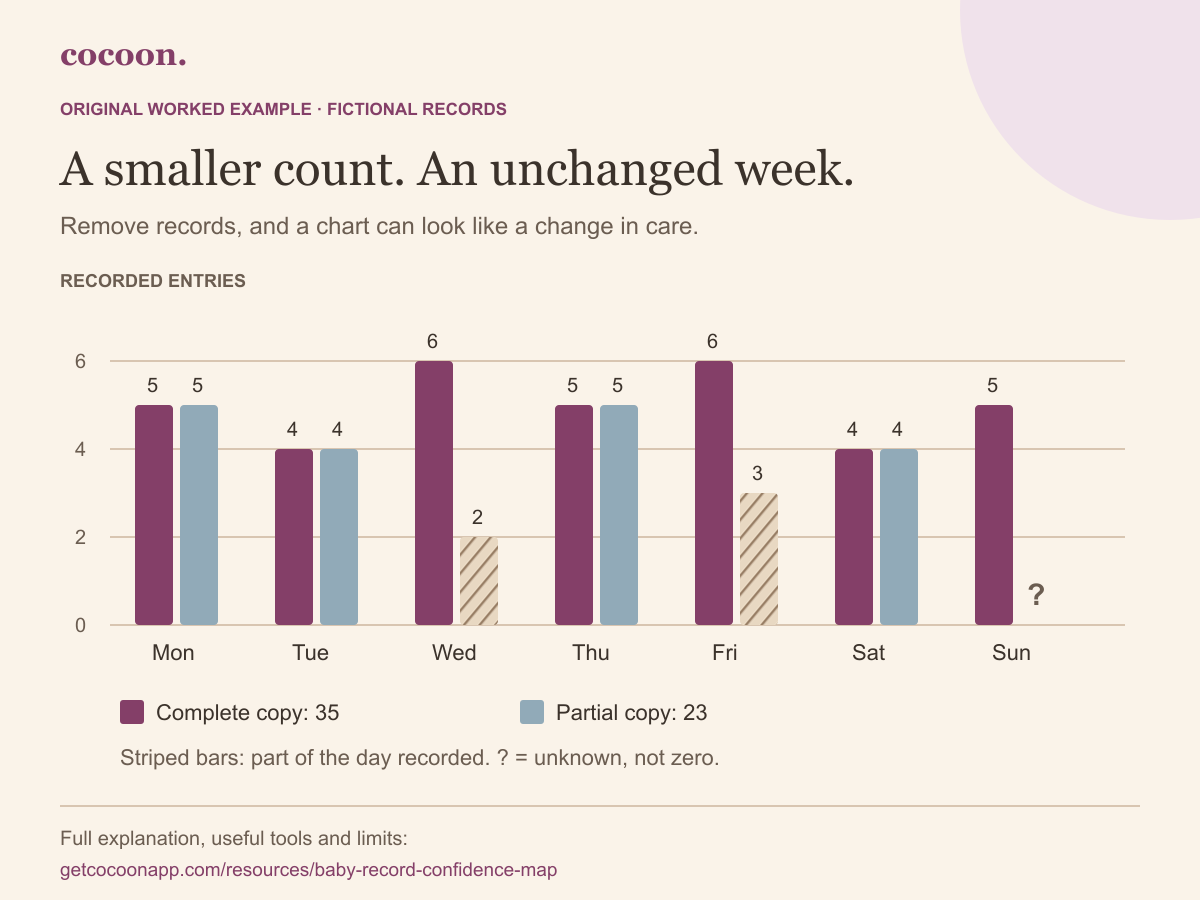
The complete fictional week contains 35 entries. The partial copy contains 23 entries, two half-days of coverage and one unrecorded day. The smaller count does not establish a change in care.
Imagine one invented week with a complete teaching record. Make a second copy, remove half of Wednesday and Friday, then remove all of Sunday. Nothing about the fictional week changed; only the available record did.
Mon5
Tue4
Wed2 · partial day
Thu5
Fri3 · partial day
Sat4
SunUnknown
23 recorded entries · 4 complete days · 2 partial days · 1 unrecorded day.
Read the coverage before the count. The partial copy is not evidence of fewer feeds or a new routine. Its 23 entries are a count of the rows retained, not a whole-week total. There is no supported way to fill Sunday by copying Saturday.
Every value in the fictional comparison
Day
Complete record: entries
Partial copy: entries
Partial copy: hours covered
Mon
5
5
24 of 24
Tue
4
4
24 of 24
Wed
6
2
12 of 24
Thu
5
5
24 of 24
Fri
6
3
12 of 24
Sat
4
4
24 of 24
Sun
5
Unknown
0 of 24
Calculation: complete copy, 5 + 4 + 6 + 5 + 6 + 4 + 5 = 35. Partial copy, 5 + 4 + 2 + 5 + 3 + 4 = 23. Four fully recorded days plus two 12-hour periods give 120 recorded hours out of 168. These coverage labels are supplied by this invented dataset; a real app cannot know coverage merely because some events were logged.
Compare only records that answer the same question over comparable periods. Do not turn these demonstration counts into feeding targets or a health conclusion. For another example, see how to read a sleep log.
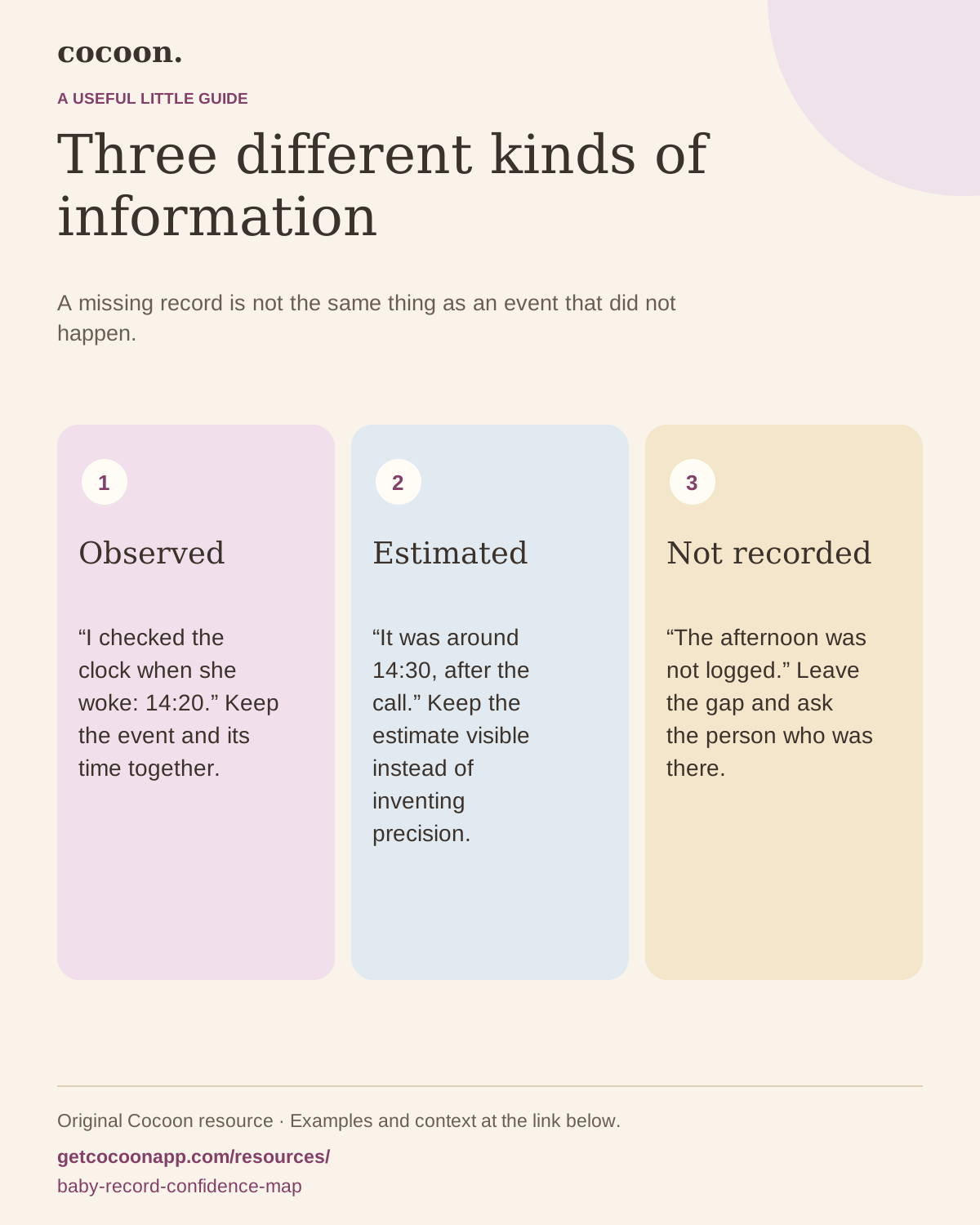
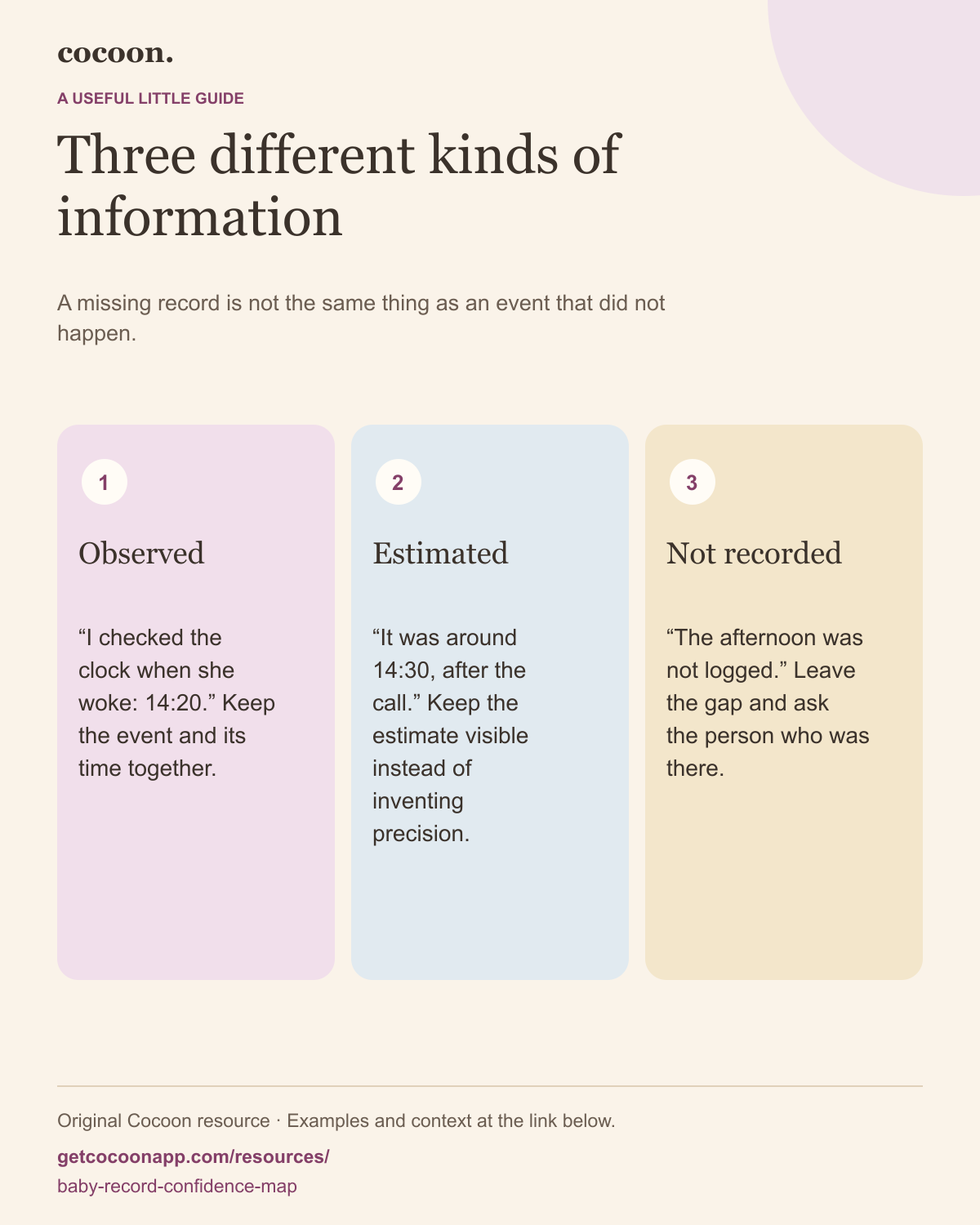
“I checked the clock when she woke: 14:20.” Keep the event and its time together.
Estimated
“It was around 14:30, after the call.” Keep the estimate visible instead of inventing precision.
Not recorded
“The afternoon was not logged.” Leave the gap and ask the person who was there.
Begin with how the entry was made
A time entered while something happens and a time reconstructed hours later have different limitations. Both can be useful if their origin is clear. Use a note such as “about,” “estimated by Sam” or “end time not recorded” instead of silently making every entry look exact.
This confidence map is Cocoon’s original record-keeping framework. It is not a validated scoring system and does not assign a health meaning to a log. The categories describe the information, not the quality of the caregiver.
Do not turn an empty space into a zero
If Monday has five recorded entries and Tuesday has three, the count alone does not prove that there were fewer events on Tuesday. First ask whether both days were recorded for the same period and by the same people. A missing afternoon changes what the comparison can tell you.
Keep a note of the coverage: “morning only,” “childcare records separate” or “phone unavailable.” If you later add information, record where it came from and avoid creating a second copy of something another adult already logged.
Choose a comparison that the records can support
Compare like with like. If one sleep duration uses the time placed in the cot and another uses the time believed to be asleep, name that difference before drawing a conclusion. If a feed spans breaks, decide whether your note describes the whole elapsed window or only active feeding.
The overnight logging guide explains dates across midnight, and the feed-interval guide separates duration from time between starts. Consistent definitions make the notes easier to discuss.
Use uncertainty in the next conversation
Instead of presenting a tidy graph as the whole story, bring one question and the limits of the record: “These are the evenings we logged; the weekend is missing.” Your care team can tell you which observations matter for that question and whether more recording would help.
Do not fill a gap just to make an app accept a complete day. A useful next step might be asking another caregiver what they remember, marking an estimate or leaving the value unknown. The appointment question sheet has room for those limits.
A fictional worked example
Give the detail a little more context
Before
“Tuesday had two fewer naps than Monday.”
With useful context
“Monday has a full-day record. On Tuesday only the morning was logged. We cannot compare the daily nap counts from these notes.”
This fictional example changes the conclusion when the coverage changes. It demonstrates a data limit, not a normal number of naps.
Keep something useful
What does this record actually tell us?
Use one question and a few entries. Do not fill gaps with invented times.
The question and the records we have
Which dates, people and parts of the day are included?
Observed details
What was recorded at the time? What definition was used?
Estimates and missing information
Label approximate values and gaps. Who might know more?
What we can say and what we cannot
Write the limit beside the conclusion and decide the next useful question.
Infographic PNG · Scalable SVG. Print the worksheet and keep completed copies private. This page has no fields for entering personal information.
You may print and share the unmodified blank resource with attribution to Cocoon. Keep its context and source link attached.
Sources and scope
Templates, prompts, visuals and fictional examples are original Cocoon material. This resource offers practical organisation and record-keeping ideas; it does not claim clinical validation. These resources do not replace individual care instructions. Editorial standards and AI-assistance disclosure.