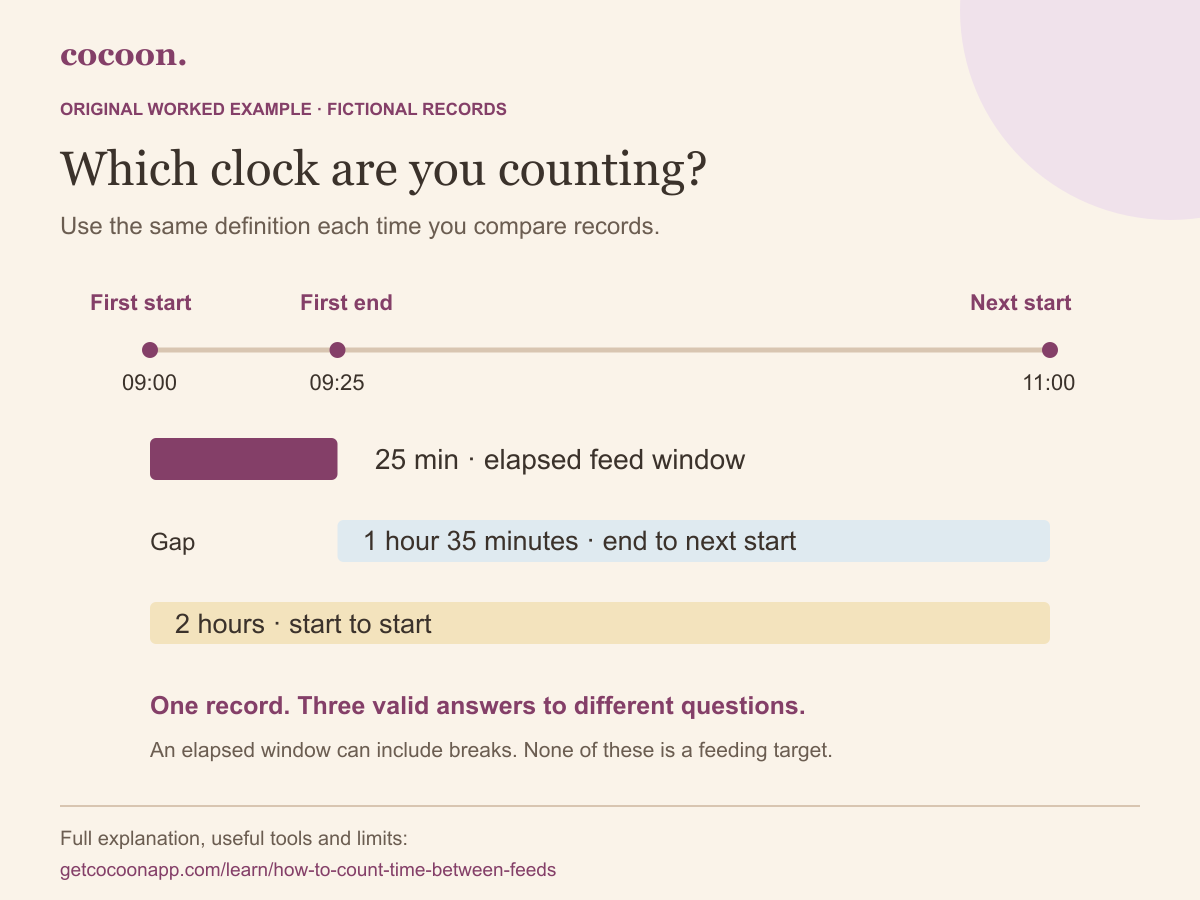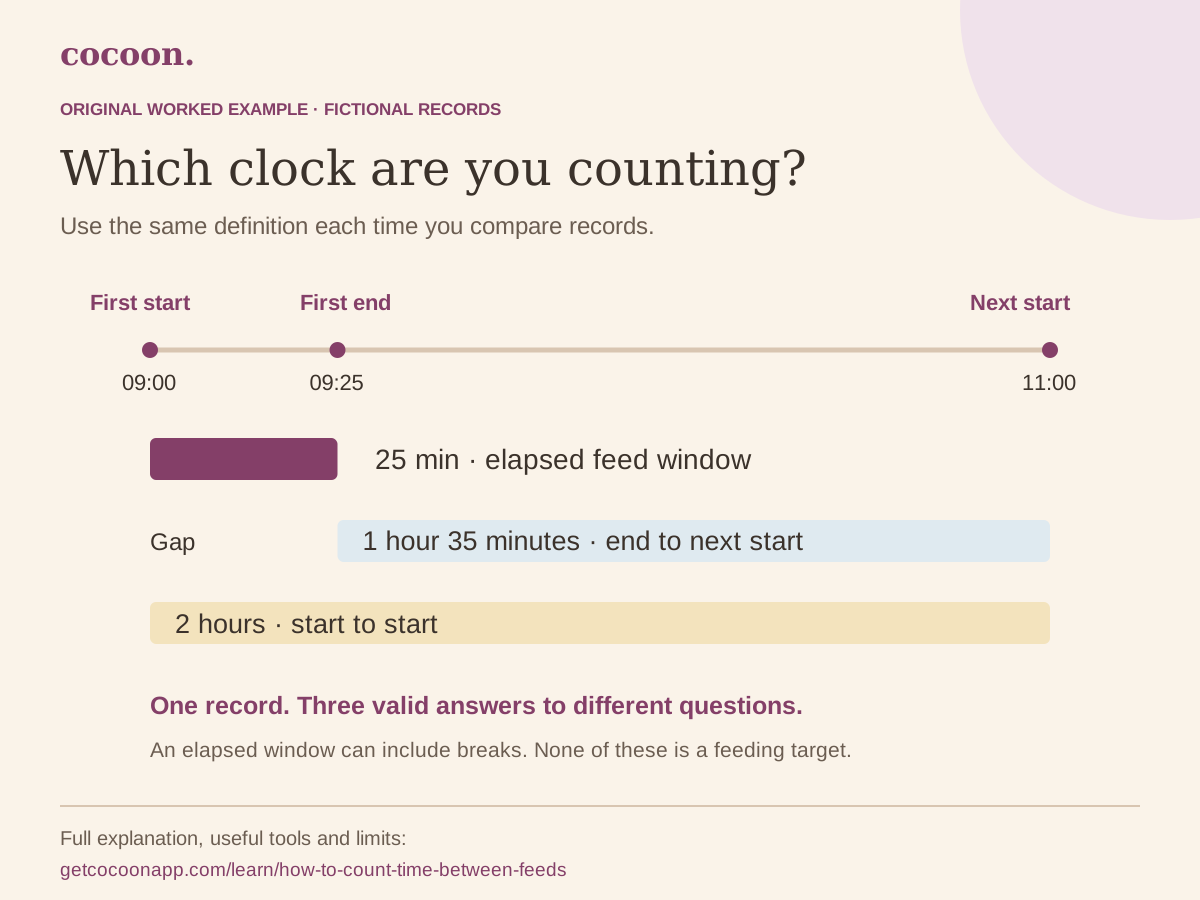
Two clocks, two different answers
Here is a made-up example to show the arithmetic, not a suggested feeding timetable:
| Record | Example |
|---|---|
| First feed starts | 09:00 |
| First feed ends | 09:25 |
| Next feed starts | 11:00 |
| Start-to-start interval | 2 hours |
| Time between the first feed ending and the next starting | 1 hour 35 minutes |
| First feed’s start-to-end duration | 25 minutes |
All three numbers are correct. They answer different questions. When comparing your records, use the same definition each time. If a clinician has given you timing instructions, ask which starting point they mean rather than interpreting it from a tracker.
What if baby feeds again ten minutes later?
You might think of an interrupted feed as one session. For example, baby starts at 09:00, stops at 09:12, resumes at 09:22 and finishes at 09:30.
The full session window is 30 minutes. The two recorded feeding periods add up to 20 minutes. The break accounts for the other 10 minutes. Neither number measures the milk baby took.
If you keep this as one feed, note the break. If your tracker records it as two entries, keep that convention consistent when comparing days. A change in how you group feeds can change the feed count without changing what your baby did.
Keep the last side easy to find
For breastfeeding, record the last side used as well as the session times if that reminder helps you. “Left, then right; finished right” is more useful at handover than “both”.
If you cannot remember a side, leave it unknown. There is no benefit in turning a guess into a precise-looking chart. For bottles, record the amount actually taken and its unit; do not mix millilitres and fluid ounces in a total.
A feed interval is not a countdown to permission
Your recorded interval describes the past. It does not tell you to withhold a feed until that interval passes again. CDC recommends paying attention to hunger and fullness signals and says babies do not need to finish a bottle. Source: CDC.
Use a note such as “fed sooner while we were out” to explain an unusual entry. Avoid concluding that a shorter interval proves low milk supply or that a longer one proves baby took enough. Bring concerns to your child’s clinician.
The printable log keeps starts, ends, side and amount in separate columns so these distinctions stay visible.
Use the calculator for arithmetic, not feeding advice
Enter the first start, its end and the next start in date order. The calculator subtracts clock readings assuming the same UTC offset throughout. It handles midnight when you enter the next date, but not a daylight-saving change or travel between time zones. For those, see the overnight clock-change examples.
The first start-to-end result is an elapsed window. If the feed included pauses, it is not active sucking time and does not measure milk transferred. None of these results sets when the next feed should happen. Input values stay in this page and are not sent by the calculator or saved between visits.