
Midnight changes the date, not the sleep
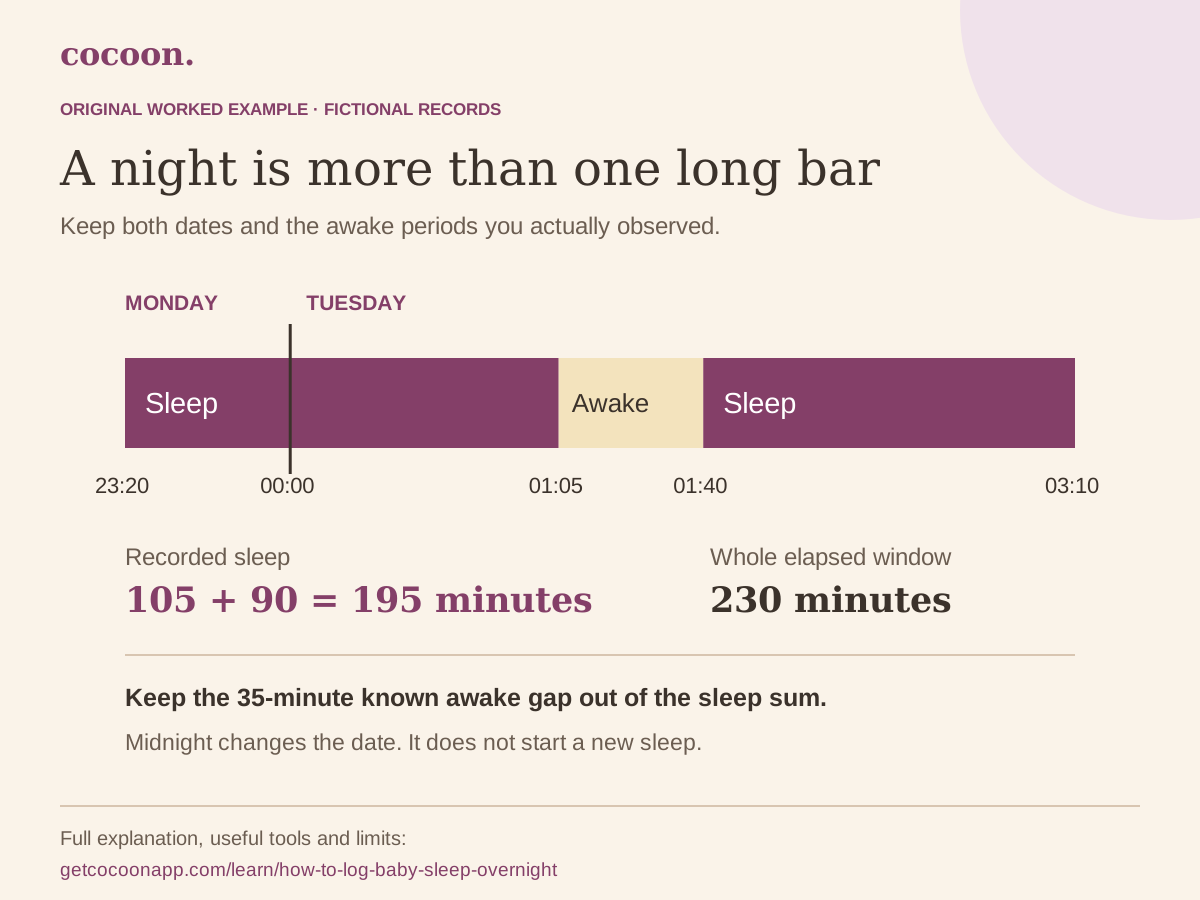
Suppose a recorded sleep starts on Monday at 23:20 and ends on Tuesday at 01:05. Its duration is 1 hour 45 minutes. Keep both dates so the finish is clearly after the start.
You do not need to wake up to stop and restart a timer at midnight. If you are using a paper diary, write the end date beside the end time. If you are correcting a digital entry, check the date as well as the clock time before saving.
These are fictional arithmetic examples, not suggested sleep lengths or a routine to aim for.
Keep an awake gap visible
Consider this made-up record:
| Event | Start | End | Recorded duration |
|---|---|---|---|
| Sleep | Monday 23:20 | Tuesday 01:05 | 1 hour 45 minutes |
| Awake; a feed is logged during this period | Tuesday 01:05 | Tuesday 01:40 | 35 minutes awake |
| Sleep | Tuesday 01:40 | Tuesday 03:10 | 1 hour 30 minutes |
The full start-to-finish window is 3 hours 50 minutes. The two sleep stretches add up to 3 hours 15 minutes. Calling the entire window “sleep” would include the known 35-minute awake period.
A feed entry alone does not establish the exact moment baby woke or fell asleep again. Record what you observed. If you do not know the sleep times, leave that uncertainty in a note rather than fitting the sleep neatly around the feed.
If you forgot to stop the timer
You look at the app at 04:00, but remember baby woke around 03:10. Correct the sleep end to about 03:10 and mark it as approximate. Do not use 04:00 simply because that is when you noticed the timer.
If you cannot remember, keep the gap visible. The previous night's times are not a substitute for tonight's missing records. A caregiver's contemporaneous note may help, but a guess should not become an exact-looking duration.
During travel or a daylight-saving clock change, note the time zone too. The same clock time can occur twice, or a clock can jump forward. Check the actual elapsed time before interpreting an unusually long or short record.
Know what a daily total includes
With a midnight day boundary, the 23:20–01:05 sleep contributes 40 minutes to Monday and 65 minutes to Tuesday. It still represents one sleep stretch. Counting the full 105 minutes on both days would double-count it.
Some diaries group a night under the evening it began or use a different day boundary. Neither display changes the underlying start and end times. Use the same grouping when comparing days, and check the dates included in an exported report.
Finally, a tidy diary is not a verdict on sleep. The NHS explains that babies have different sleep patterns and that patterns change. Source: NHS. Use a few clear records to remember the night, not a graph as a reason to change feeds or force a routine.
The printable sleep log includes separate start and end dates. For the next daytime question, read how to work out time since waking.
When two clock hours are not two elapsed hours
The lab uses two NSW changes: clocks move from 02:00 to 03:00 on 4 October 2026, and from 03:00 to 02:00 on 4 April 2027. Other places use different dates or do not change clocks. Source: NSW Government.
In our forward-change example, 01:30 at UTC+10 to 03:30 at UTC+11 is one elapsed hour. In the back-change example, 01:30 at UTC+11 to 03:30 at UTC+10 is three elapsed hours. The clock labels differ by two hours in both. These are timestamp demonstrations, not sleep expectations.
Keep both offsets when checking an export across a change. If an old record has only a repeated local time and no offset, the file alone may not tell you which occurrence was intended. Ask the original caregiver or check another contemporaneous record; do not add an hour just to make a graph look plausible.