Start with the destination, likely time away and facilities you have confirmed. Choose the supplies your child normally uses, decide who carries them and plan what you will do if the outing changes. Use the checklist as a prompt, not a universal shopping list.
Original template · Practical example · Visual guide
A practical next step
Reset the bag for the next handover
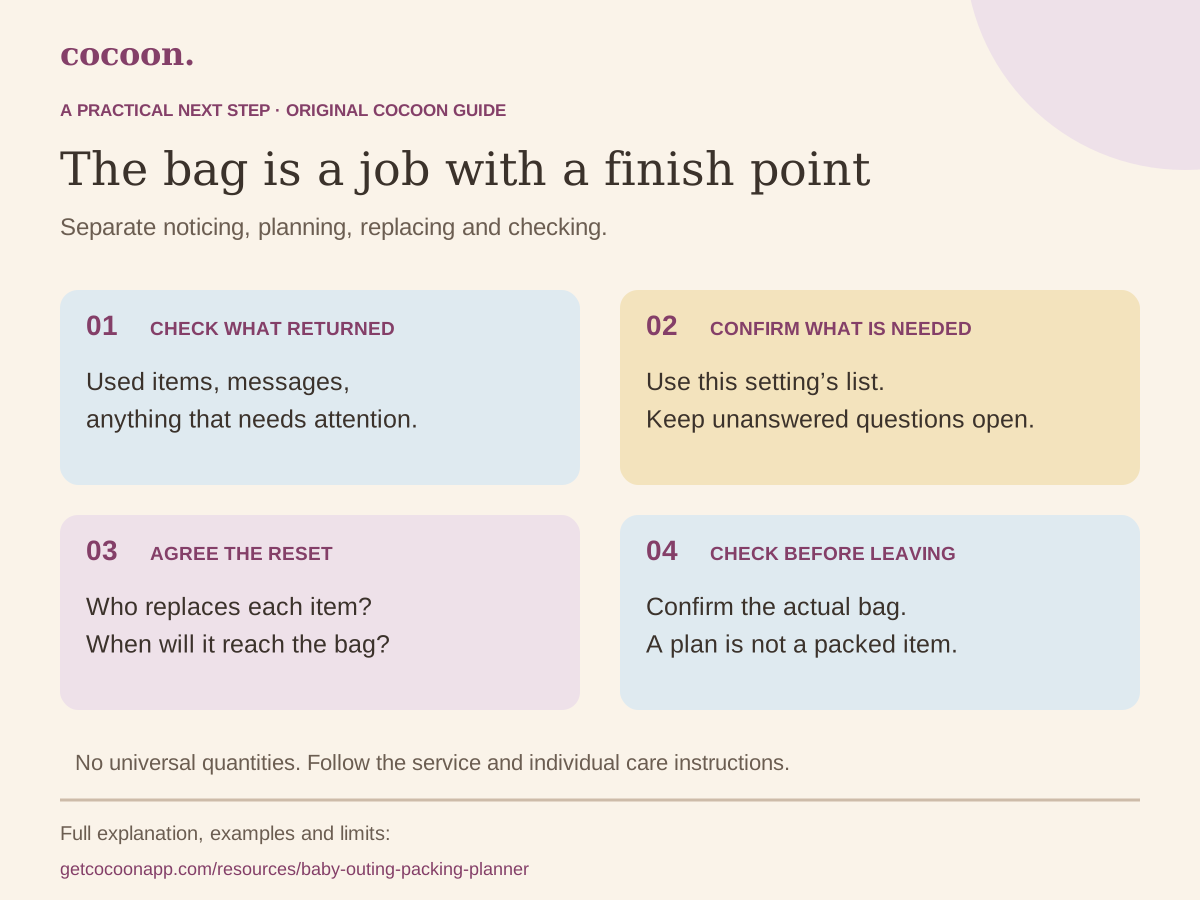
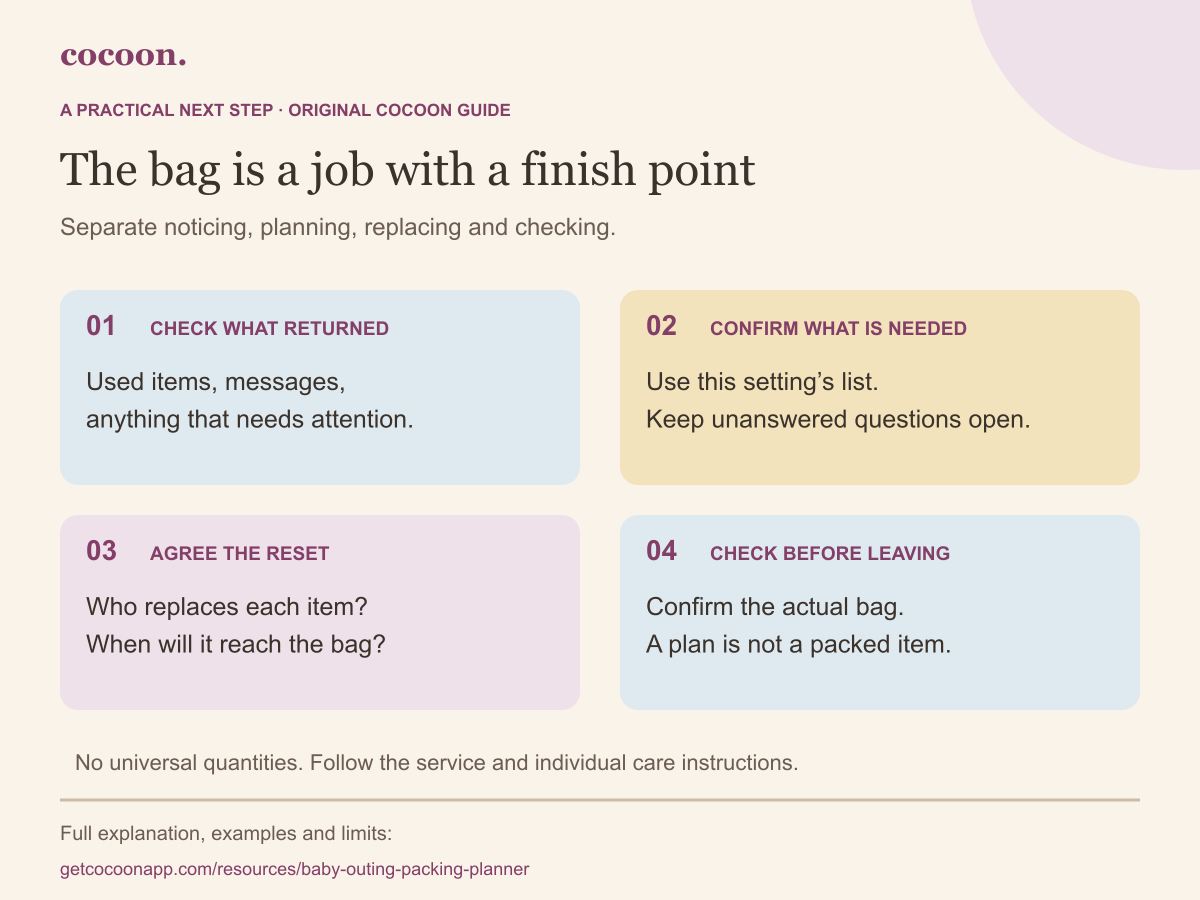
The bag by the door is only the visible part of the job. Someone still has to notice what was used, check the service’s message and replace what is missing. This reset tool separates those decisions so “I packed it” does not quietly mean “I assumed it was already there”.
Check what came home, what the service supplies and what needs replacing. Leave an unanswered question visible.
The steps and worked examples are explained in full below.
Make a plan for the categories that apply. These selections stay in this page and reset when it is reloaded. They are not a saved checklist or a confirmation that a bag is ready.
Check what was used, what still fits and the service’s requested supply.
Confirm what the service supplies and how it requests replenishment.
Use the service’s handling rules and the child’s individual instructions; this tool gives no quantities or storage times.
Check whether it is allowed, where it may be used and who brings it home. This is not sleep-space advice.
Check the actual outing or service plan and its requirements.
Use the required channel for care plans, authorisations and changes. A packed bag is not confirmation.
6 categories still need a decision
Confirm each category against this visit’s requirements. The worksheet has space for an owner and the departure check.
Read every category and its limits
Spare clothes
Check what was used, what still fits and the service’s requested supply.
Nappies / diapers and changing supplies
Confirm what the service supplies and how it requests replenishment.
Feeding items
Use the service’s handling rules and the child’s individual instructions; this tool gives no quantities or storage times.
An agreed comfort item
Check whether it is allowed, where it may be used and who brings it home. This is not sleep-space advice.
Items requested for the weather
Check the actual outing or service plan and its requirements.
Forms, messages and pickup changes
Use the required channel for care plans, authorisations and changes. A packed bag is not confirmation.
Start with what this setting actually needs
Use the service’s own list as the authority for that visit. Some supplies stay there; some come home each day. Ask how replenishment requests arrive and where labelled items belong. The categories below are prompts to adapt, not a universal packing list. They do not specify feeding amounts, storage times, medication or safe-sleep arrangements.
Give checking and packing a clear owner
After care, one adult can look through what returned and check the latest message. The adult doing the next departure then confirms the replacement items are actually in the bag. They may be the same person. The useful distinction is between noticing a job, agreeing to do it and finishing it.
Work a small example all the way through
In this fictional example, spare clothes came home used. Sam agrees to replace them that evening. Alex is doing drop-off and checks the bag before leaving. The service supplies changing items, but nobody has confirmed whether that applies to the first visit. Clothes belong in “family will pack”; changing supplies stay in “still need to confirm” until answered. Selecting “will pack” does not mean the item has been packed.
Reset the list when the visit changes
An afternoon with a relative is a different setting from a full childcare day. Recheck the categories when the destination, weather, collection arrangement or service request changes. Keep the amount of detail small enough that the departing adult can use it. Required forms and individual care instructions remain separate.
Original Cocoon planning ideas and fictional examples. These have not been validated in a parent usability study.
The idea at a glance
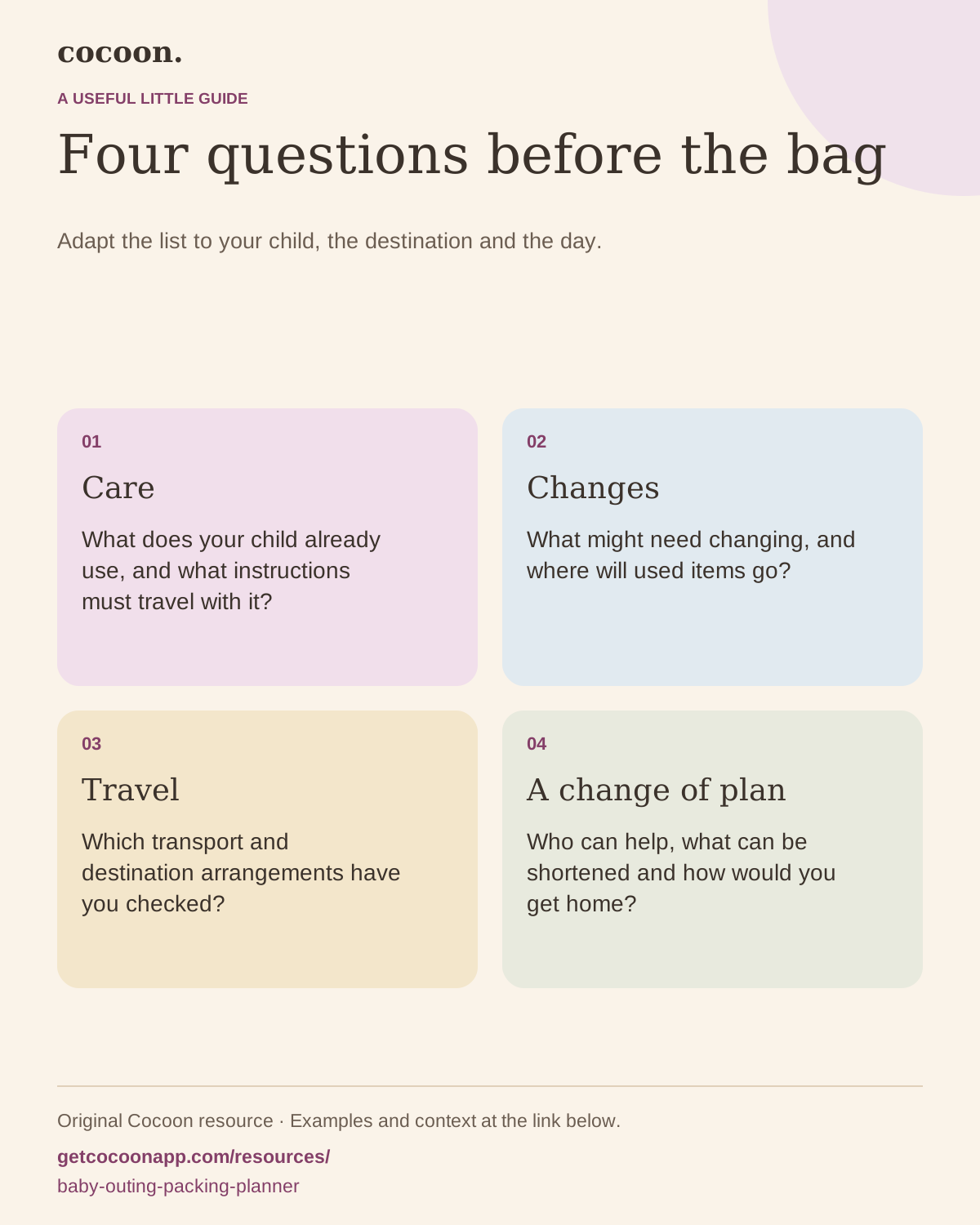
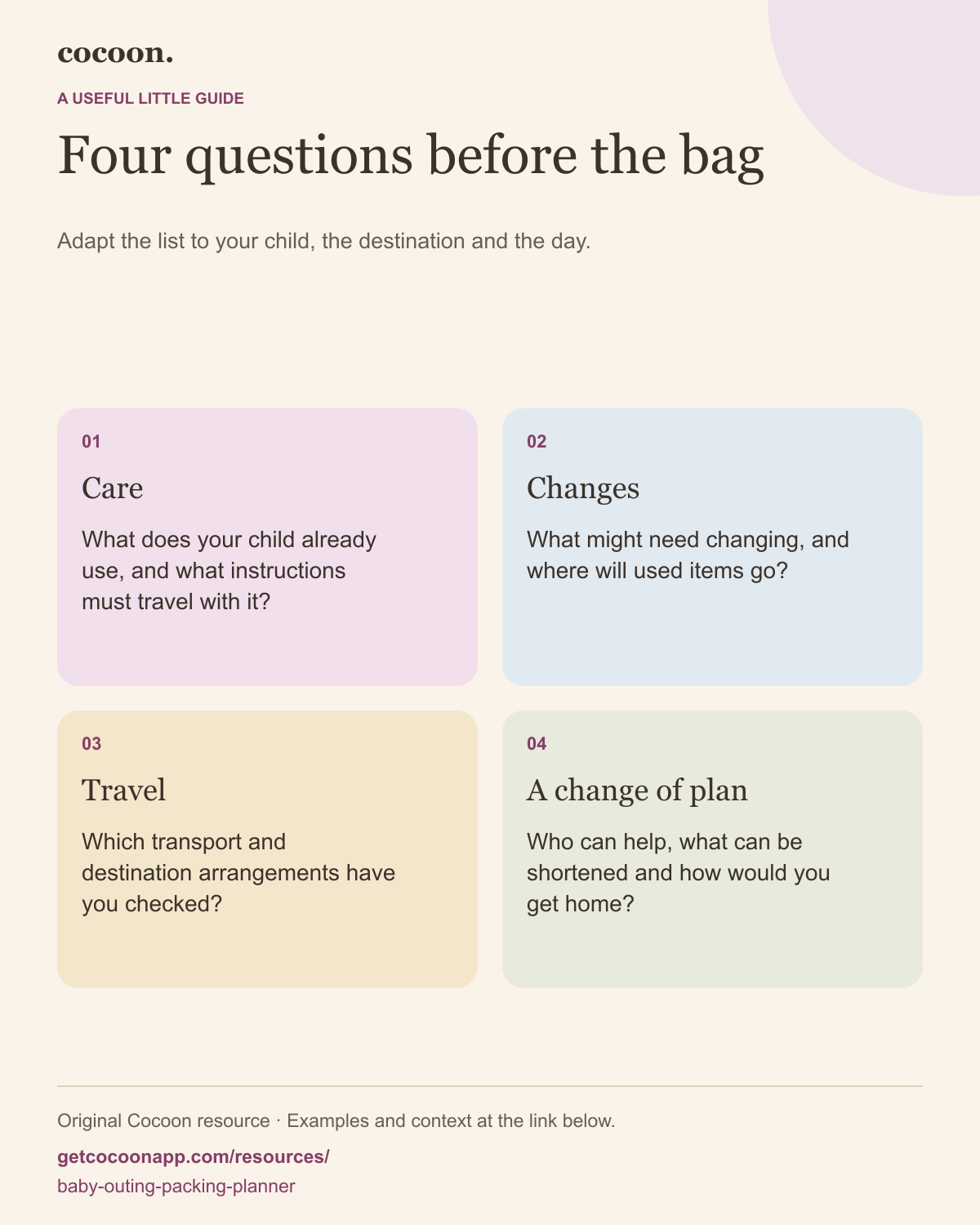
Four questions before the bag
Adapt the list to your child, the destination and the day.
What does your child already use, and what instructions must travel with it?
Changes
What might need changing, and where will used items go?
Travel
Which transport and destination arrangements have you checked?
A change of plan
Who can help, what can be shortened and how would you get home?
Check the destination before adding more things
Write down where you are going and what you actually know about the facilities. Is there a place to change your baby? Can you return to the car or home easily? Are there steps, entry restrictions or opening times that affect your plan? Mark anything you still need to check.
The worksheet does not recommend a standard number of nappies, bottles or outfits. Those choices depend on your child and the outing. Start from your own experience and any individual care instructions rather than treating a generic packing list as a target.
Give each item a place and an owner
For a shared trip, deciding what to pack is only half the job. Agree who checks the bag, who carries it and which pocket holds the item someone may need quickly. If each adult assumes the other packed a spare outfit, the list has not solved the problem.
Separate clean items from used ones using whatever arrangement works for your supplies. Keep any required care documents accessible to the adult who needs them, without including private information in a broadly shared checklist.
Use dedicated guidance for safety questions
A packing planner is not a guide to transporting a baby, preparing feeds or setting up a sleep space. Check the relevant car-seat guidance, safe-sleep guidance and travel guide when making those arrangements. Follow current product instructions and your child’s individual care plan where relevant.
If another caregiver will be responsible for part of the outing, talk through the arrangements directly. Do not assume that a tick beside “feeding things” tells them how those items should be used.
Pack a way to change the plan
Include a practical fallback: a shorter visit, a different adult collecting you or a clear point at which you head home. A successful outing does not have to last as long as you originally imagined.
Afterwards, note one thing you used, one thing you could leave out and one thing you wished you had checked. Save that version for a similar trip instead of building a bigger and bigger bag for every possible event. This planner is an original organising framework, not a product recommendation.
A fictional worked example
Give the detail a little more context
Before
“Bring the usual baby bag.”
With useful context
“Library visit, close to home. Jo checks and carries the bag. We have confirmed the changing facilities. If the visit needs to end early, we can walk straight home.”
This fictional plan connects the bag to a real destination and a named adult. It deliberately leaves quantities to the family’s own needs.
Keep something useful
Our next outing
Plan for this trip. Check safety guidance and individual instructions separately.
Destination, time away and confirmed facilities
Separate what you know from what you still need to check.
Care and changes
Use your own supplies and care instructions; assign who packs them.
Transport, access and who carries what
Confirm arrangements and keep needed instructions available.
Fallback and what we learned
How could we shorten the trip? What would we change next time?
Infographic PNG · Scalable SVG. Print the worksheet and keep completed copies private. This page has no fields for entering personal information.
You may print and share the unmodified blank resource with attribution to Cocoon. Keep its context and source link attached.
Sources and scope
Templates, prompts, visuals and fictional examples are original Cocoon material. This resource offers practical organisation and record-keeping ideas; it does not claim clinical validation. These resources do not replace individual care instructions. Editorial standards and AI-assistance disclosure.