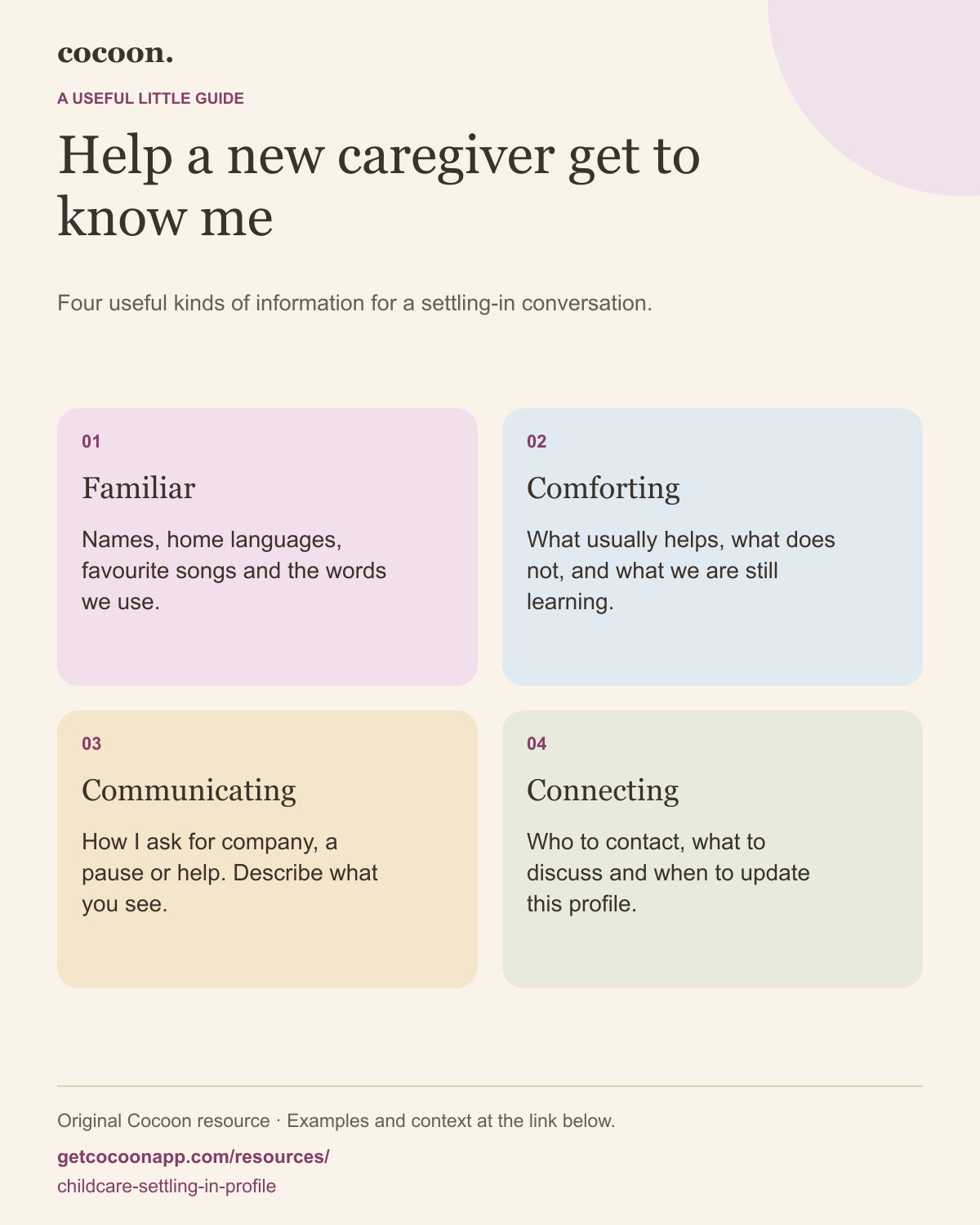
What belongs on a one-page profile?
Choose details an educator can use in an ordinary moment. Include the name your child hears at home, how to pronounce it, a familiar song and the words your family uses for everyday things. Describe preferences without turning them into fixed rules: “often enjoys looking out of the window with an adult” leaves room for a different day.
Keep required information in the service’s own system. This page is an introduction, not an allergy action plan, permission form or replacement for an individual care plan. Ask how the service wants those documents supplied.
Turn a label into an observation
“She is difficult at drop-off” gives the next person little to work with. “She often reaches for me at the door; we have been practising a short goodbye with her educator” describes a situation. It also avoids presenting a temporary experience as a personality trait.
Write “we are still finding out” where the answer is uncertain. Educators may notice preferences you have not seen at home. Leave space for their observations rather than trying to predict the whole first week.
Bring the profile into a conversation
Raising Children Network recommends sharing information about a child’s health, wellbeing, likes and dislikes before starting care Source 1. Cocoon’s profile prompts below are an original way to organise that conversation.
Ask which details are most useful, who will be the main contact and how changes should be communicated. Agree on one place for updates so that an old printed sheet does not quietly become the latest version. Date any revision and point out what changed.
Review what actually helped
After the first few visits, look at the profile together. Keep a detail that made a real interaction easier; remove a sentence nobody used. Add the educator’s wording with their agreement. A profile can stay brief while becoming more accurate.
For general settling-in guidance, read the starting childcare guide. For day-to-day information between adults, use the separate caregiver handover card. One introduces a child; the other explains what happened today.