Start with a trial day. Give each recurring task an owner, a backup and a clear finish point. Then decide how you will tell each other about a change. Review the plan after real experience rather than treating the first version as a permanent arrangement.
Original template · Practical example · Visual guide
A practical next step
What changed, and who has agreed?
A plan needs a short history when the adults using it change shifts, transport or responsibilities. “We do Tuesdays differently now” is hard to act on. A dated change note says what changes, why you are trying it and who has actually agreed.
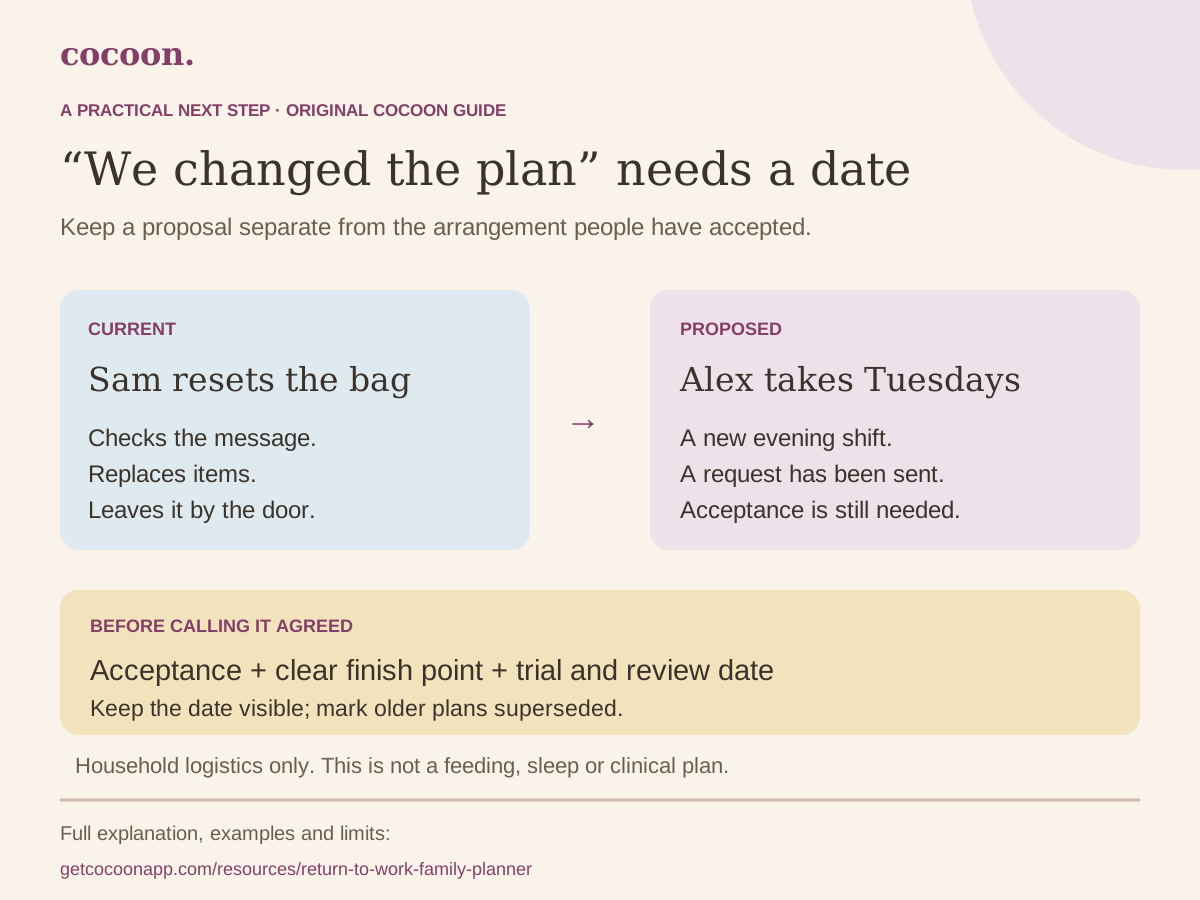
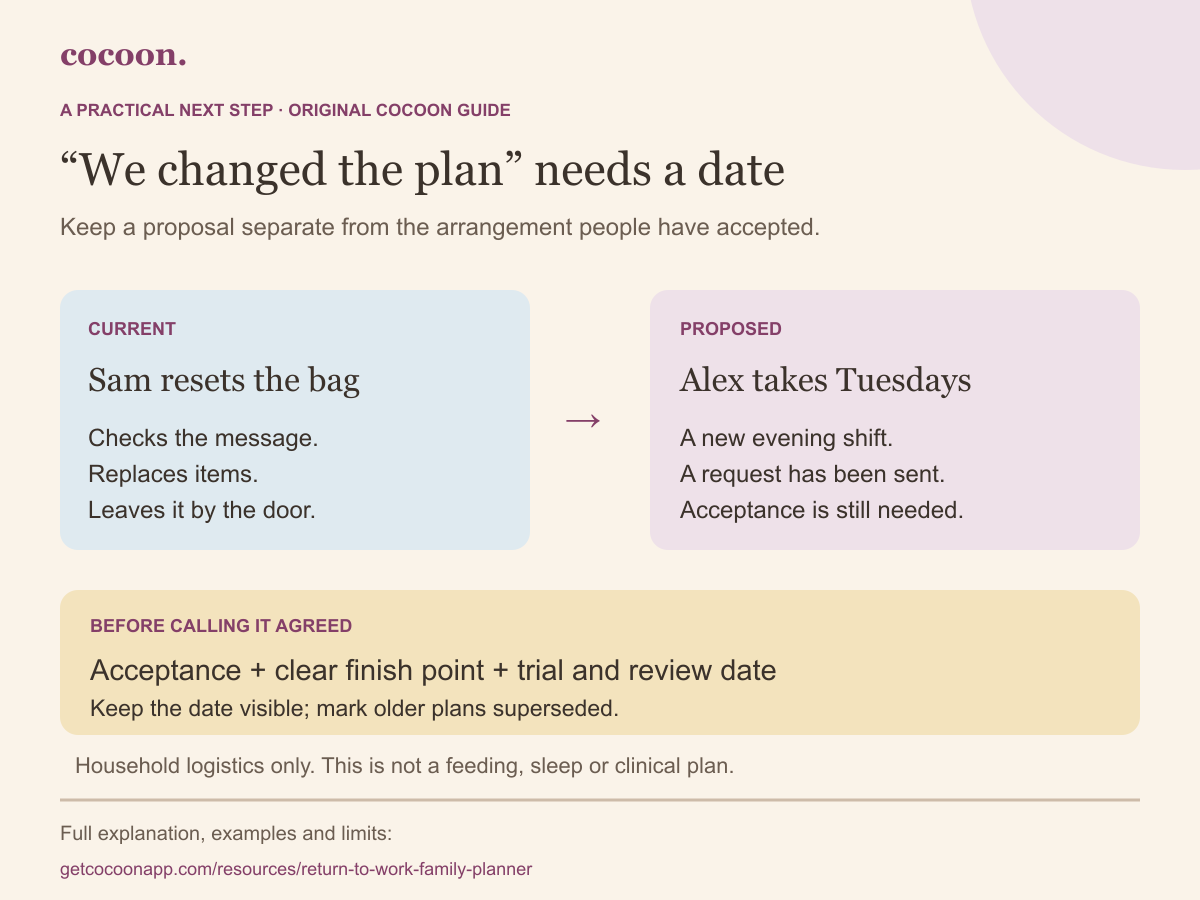
A proposed change becomes the agreed plan only after the people doing it confirm. Keep a date, a reason and a review point.
The steps and worked examples are explained in full below.
An invented Tuesday bag-reset arrangement. This changes a household task, not a child’s care instructions.
Current arrangement
Sam resets the bag
After care, Sam checks the service’s message, replaces used items and leaves the bag by the door.
Proposed — not yet agreed
Alex takes Tuesdays
A new evening shift means Sam asks Alex to do the Tuesday reset. Sam continues to arrange the task until someone accepts.
Still a proposal. A request has not transferred the responsibility.
Read the completed fictional change note
Reason and proposal
Sam starts an evening shift. Alex is asked to own Tuesday bag reset.
Agreement and finish point
Alex agrees on 17 October. Reset means checking the message, replacing used items and leaving the bag by the door.
Trial and review
Try Tuesday 20 October; discuss what happened on Wednesday 21 October. Contact each other sooner if the arrangement stops being workable.
Version
Mark the old Tuesday note superseded. Keep the new date visible.
Change one arrangement, not the whole family
Choose a practical task such as bag reset, pickup communication or checking the service’s messages. Record the current arrangement without blame. Then write a proposed change that another adult could repeat back. Keep feeding, sleep and medical instructions out of a logistics experiment; discuss those through the appropriate care team.
Keep proposed and agreed visibly different
In the fictional example below, Sam usually resets the bag after care. A new evening shift makes that difficult, so Alex is asked to reset it on Tuesdays. Until Alex agrees, Sam still needs to arrange a workable reset. A colourful note or an updated calendar cannot supply another person’s acceptance.
Keep a small record of what happened
Write the first trial date, what completed the task and what was awkward. “The spare clothes were replaced before morning; the message about a missing hat was not seen” is more useful than “Tuesday failed”. Agree what to keep or change at the review. Retain the earlier note as superseded so a relative finding an old printout can tell which version applies.
Give a change a stopping point
Choose when to check the arrangement again and what would trigger an earlier conversation. This is your own reminder; the worksheet and browser example do not schedule notifications. If circumstances change before the review, contact the people affected rather than silently treating the draft as the new plan.
Original Cocoon planning ideas and fictional examples. These have not been validated in a parent usability study.
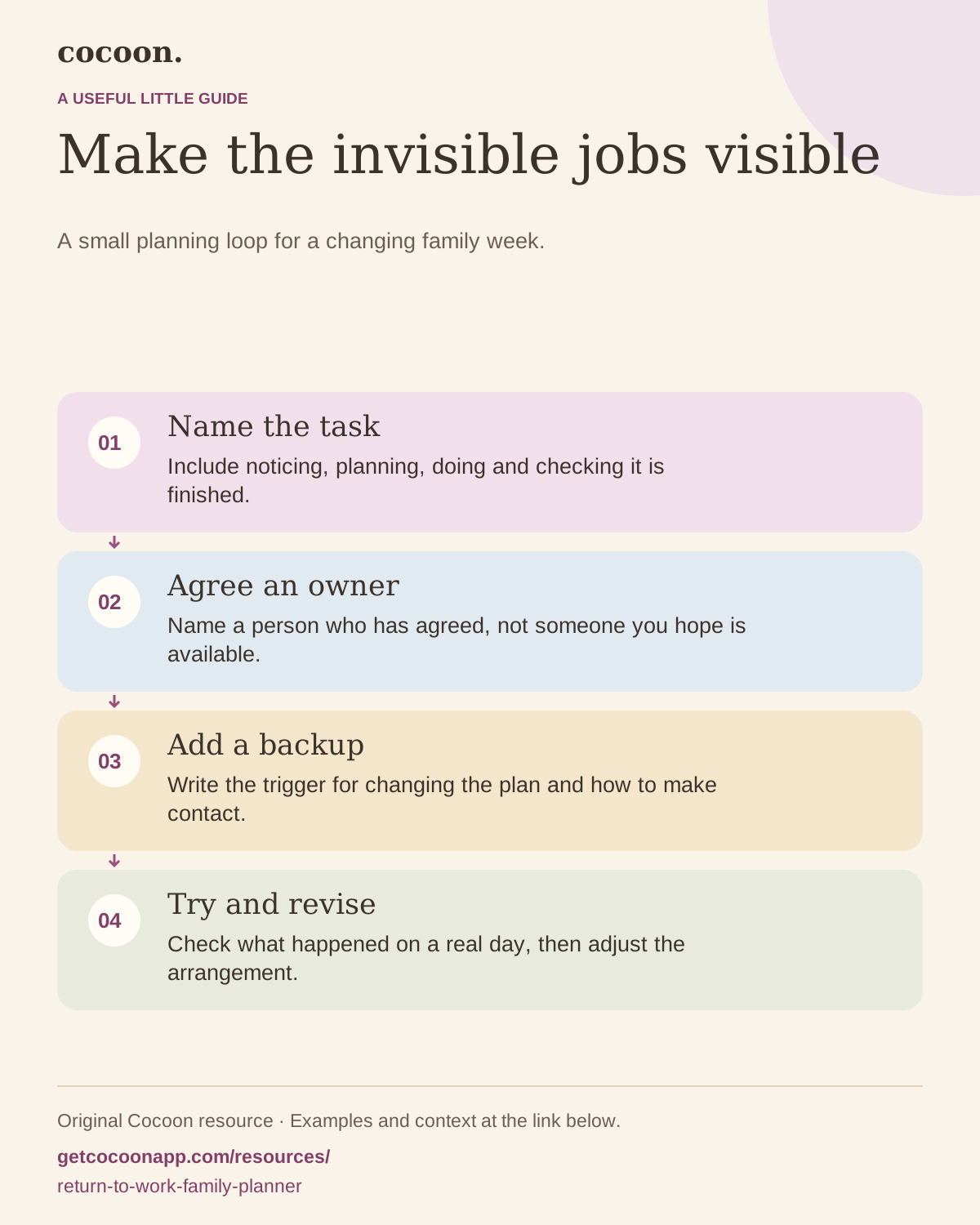
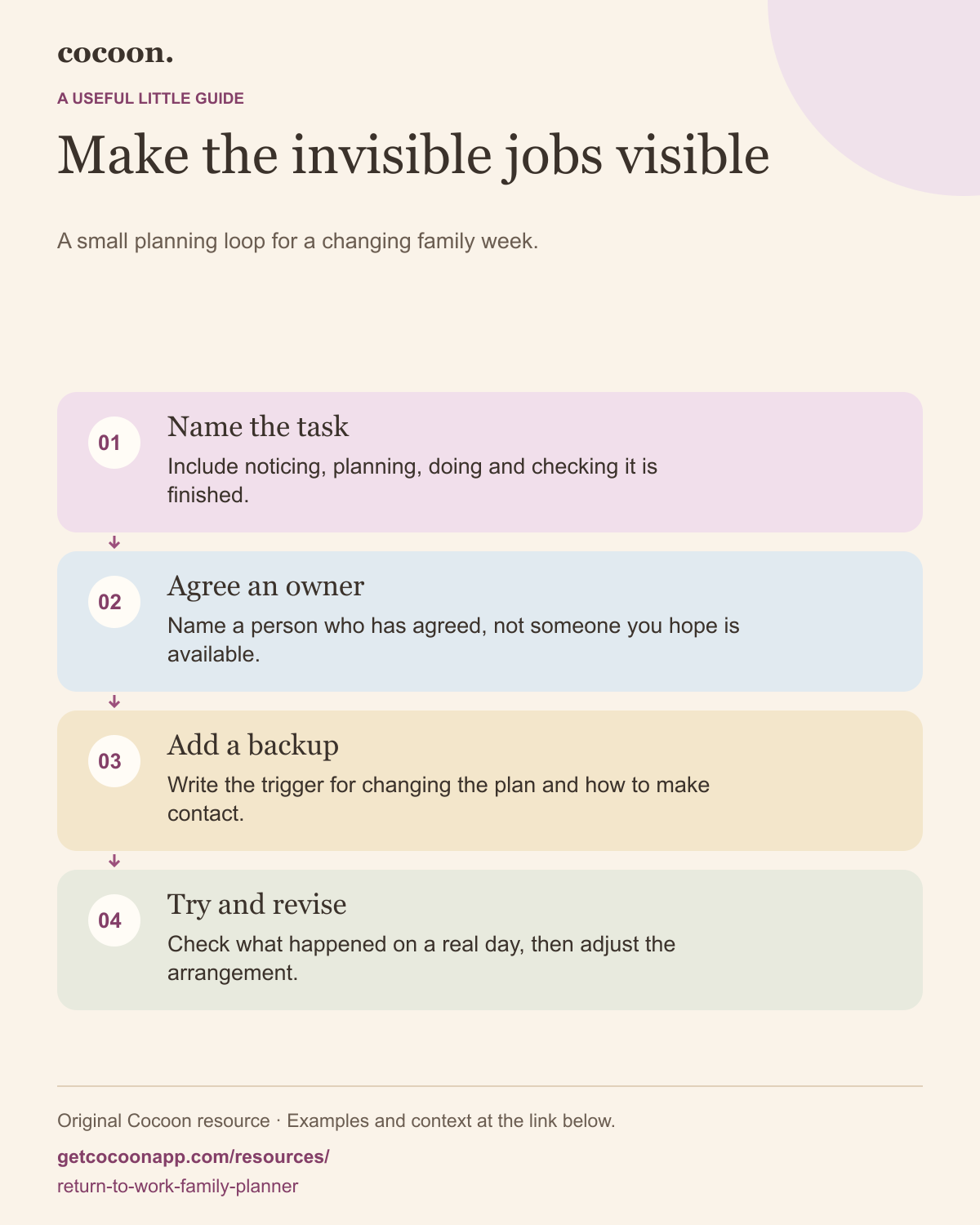
Include noticing, planning, doing and checking it is finished.
Agree an owner
Name a person who has agreed, not someone you hope is available.
Add a backup
Write the trigger for changing the plan and how to make contact.
Try and revise
Check what happened on a real day, then adjust the arrangement.
Start with the journey through one day
Walk through a workday from the first person leaving home to the last bag being unpacked. List the easily missed jobs: checking messages from care, replenishing spare clothes, charging a phone, finding a pass and telling another adult about an altered pickup.
Keep the first list factual. This is not a scorecard for who contributes more. A useful question is “what has to happen for this task to be complete?” Packing a bag is a different task from remembering which supplies need replacing.
Give a job a finish point
For each task, add a short definition of done. “Pickup” might mean collecting the child, hearing the educator’s update and passing on anything the next caregiver needs. “Supplies” might mean checking the bag after care, replacing what was used and putting it by the door.
Agree ownership directly. A friend or grandparent is not a backup until they have accepted that role and know how they will be contacted. Keep addresses, access arrangements and private contact details on your own copy.
Use a trial day to find friction
Raising Children Network discusses arranging care and sharing responsibilities when returning to work Source 1. This worksheet concentrates on family logistics; employment rights, leave entitlements and childcare fees need current local advice.
A rehearsal can be a walk-through rather than a perfect simulation. Find out which opening times, transport connections and workplace constraints are real. Mark what you have confirmed and what remains an assumption. If a plan requires every connection to work exactly, decide what happens when one does not.
Review the arrangement without grading the family
Choose a short review point after you have tried the plan. Ask which task was repeatedly forgotten, which handover needed more information and whether one adult had to keep prompting everyone else. Revise one or two things rather than rewriting the whole week.
Use the settling-in profile for a new care setting and the returning to work guide for feeding and transition questions. The planner organises responsibilities; it does not prescribe a feeding or sleep routine.
A fictional worked example
Give the detail a little more context
Before
“Sam does pickup; Alex helps when needed.”
With useful context
“Sam confirms pickup each morning. If a meeting changes that, Sam calls Alex to agree a replacement before telling the service. Alex is the backup only after confirming.”
A named task and an acknowledgement close the gap between asking for help and knowing that someone has accepted it.
Keep something useful
Our return-to-work trial day
Agree responsibilities, test one day and keep the parts that work.
The day, including the small jobs
What must happen before leaving, during care and after getting home?
Owner and definition of done
Who has agreed, and what completes each job?
Backup and change of plan
What triggers a change? Who confirms they can take over?
What we learned and what changes next
Date the review. Note assumptions that still need checking.
Infographic PNG · Scalable SVG. Print the worksheet and keep completed copies private. This page has no fields for entering personal information.
You may print and share the unmodified blank resource with attribution to Cocoon. Keep its context and source link attached.
Sources and scope
Templates, prompts, visuals and fictional examples are original Cocoon material. The references below support the specifically cited context, not the entire template. They do not endorse Cocoon. These resources do not replace individual care instructions. Editorial standards and AI-assistance disclosure.