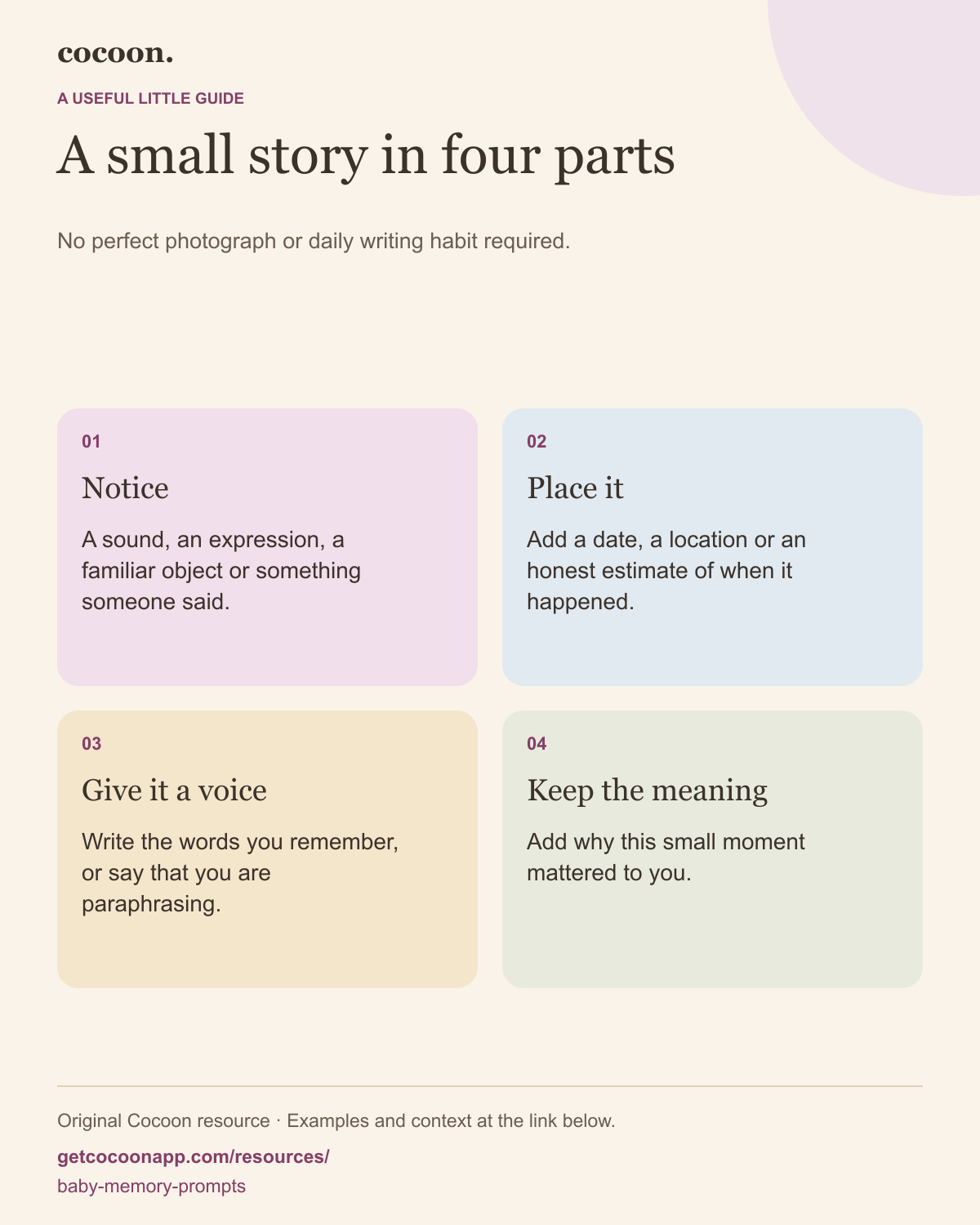
Write the detail only you can supply
“A lovely day” is a feeling. “You watched the washing turn and shouted at every yellow sock” is a scene. Start with what you saw, heard or did. If you have a photograph, write one thing the image cannot tell a future reader: who was behind the camera, why everyone laughed or what happened next.
The prompts below are Cocoon’s original writing invitations. They are not a development checklist and do not assume a particular family structure, ability or milestone timeline.
Use a prompt without turning it into homework
Pick the question that brings a detail to mind. Skip the rest. You can answer with three words, a voice note, a drawing or a photograph with a caption. There is no need to work through the list in order or make up a memory to fill a gap.
If a difficult period has few entries, you can write about it later or leave the space alone. A keepsake does not have to present a cheerful version of every day. Choose what feels right to preserve and who, if anyone, should see it.
Keep your voice and other people’s boundaries
A grandparent’s phrase, a family nickname or a word in your home language can make a story recognisable. Preserve the spelling you use, and add a translation if you want future readers to understand it. Ask before including another adult’s private story or sending a photograph beyond its original audience.
You can keep two versions: a full private memory and a shorter version for relatives. The family photo-sharing plan can help you agree where shared copies belong.
Make the memory findable later
Give the entry a useful title, such as “The yellow socks at Nan’s,” rather than “Update.” Add a date or a labelled estimate, and connect a related photo if you have one. A small amount of context can make a search years later much easier.
Try opening a sample export outside your journal app so you know which text and files it preserves. The backup checklist walks through that check. The goal is a memory you can return to, not a complete record of every day.