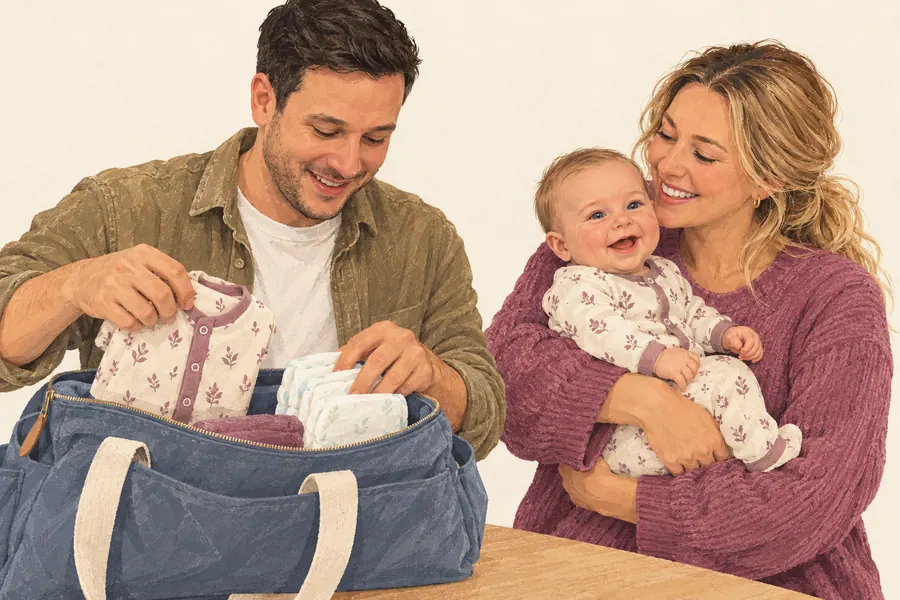
Aim to have your hospital bag packed by around 36 weeks. The NHS hospital bag checklist suggests packing at least 3 weeks before your due date, because only about 1 in 20 babies arrive on the day itself. You need four groups of things: paperwork, what you'll want in labour, what you'll need for the days after the birth, and a few basics for your baby, plus a fitted car seat for the trip home. Hospitals differ in what they supply, so check with yours before you buy extras.
When should I pack my hospital bag?
- NHS (UK): at least 3 weeks before your due date.
- Better Health Channel (Australia): Victoria's Better Health guide to packing for hospital suggests starting to plan early in the third trimester (after 29 weeks) and having the bag packed at around 36 weeks.
If you are booked for an induction or a caesarean, you'll know the date, but labour can still start before then. Australia's Pregnancy, Birth and Baby guide to going to hospital suggests a practice run of the trip during the third trimester, knowing where to park, and planning not to drive yourself while in labour.
What documents should I bring?
Keep these together in one folder or zip pocket so whoever is with you can find them:
- your hospital or maternity notes, or antenatal card or records
- your birth plan, if you have one
- in Australia, your Medicare card and any private health insurance details, as Australia's Pregnancy, Birth and Baby birth bag checklist lists
- your obstetrician's or midwife's contact details and any completed hospital paperwork
- a card or a little cash for parking and vending machines.
The Australian Pregnancy, Birth and Baby site suggests leaving jewellery and other valuables at home.
What should I pack for labour?
| Item | Why it helps |
|---|---|
| Loose, comfortable clothes or an old nightie or T-shirt | Easy to move in, and you won't mind if it gets messy |
| Dressing gown, slippers or thongs, warm socks | For walking around in early labour |
| Lip balm, hair ties, a water bottle (a straw helps) | Small comforts during labour |
| Snacks and drinks | For you and your support person |
| Phone, a long charging cable or battery pack | Calls, music, photos |
| Glasses or contact lenses | Bring glasses if a caesarean is possible |
| A fan or water spray, eye mask, your own pillow | Comfort |
| Music, books or podcasts | For a long early labour |
| TENS machine and spare batteries, if you plan to use one | Pain relief you've arranged |
| Any regular medicines | Tell your midwife what you take |
What will I need after the birth?
The NHS list and Australia's Better Health Channel list include:
- maternity pads: the NHS suggests two packets of super-absorbent pads
- underwear: five or six pairs of comfortable knickers, or plenty of disposable ones
- bras: two or three comfortable bras, nursing bras if you plan to breastfeed (the Australian Better Health Channel suggests avoiding seams and underwires), and breast pads
- nightwear that opens at the front or is loose, if you are breastfeeding
- day clothes: about three changes of comfortable clothes, and a going-home outfit that still fits a postnatal tummy
- toiletries: a wash bag with toothbrush, hairbrush, flannel, hand sanitiser and anything else you use, plus a towel
- ear plugs and an eye mask for a noisy ward
- a spare bag for dirty laundry.
Extra items for a caesarean
Australia's Better Health Channel suggests:
- large underwear that doesn't sit on your wound
- clothing without a waistband
- comfort food, mouthwash, dry shampoo and sugar-free chewing gum.
Contact lenses can't be worn during a caesarean, so pack glasses. See postpartum recovery for what to expect in the days after.
What does my baby need in the hospital bag?
| Item | Notes |
|---|---|
| Bodysuits, singlets and sleepsuits | A few, in more than one size |
| Going-home outfit | Plus a hat and socks or booties |
| Scratch mittens | Optional |
| Blankets or wraps | Two light blankets (Better Health, Australia) |
| Nappies | Allow 8 to 10 a day (Pregnancy, Birth and Baby, Australia) |
| Wipes or cotton wool, muslin squares | Check whether the hospital supplies them |
| Snowsuit | Only if it is cold where you live |
| Bottles and formula | Only if you plan to formula feed; check what the hospital provides |
| A baby carrier or pram | Australia's Better Health says hospitals may not let you carry your baby around in your arms |
For help planning feeds, see preparing to breastfeed.
What should my birth partner or support person pack?
The NHS checklist suggests:
- a change of clothes, toothbrush, toothpaste and deodorant
- phone, charger and a camera if they want one
- snacks and drinks
- swimwear if they might get into a birth pool with you
- any medicines they take, and spare glasses or contact lenses
- coins or a card for the car park and vending machines.
Pregnancy, Birth and Baby, the Australian Government's pregnancy service, adds a pillow. If you have other children or pets, arrange who will look after them and when. For more on how partners can help, see partner support.
What does the hospital usually provide?
It varies. Australia's Better Health Channel notes that hospitals have different policies on what they provide for your baby, such as blankets and nappies, and suggests asking whether maternity pads and pillows are supplied. The Australian Pregnancy, Birth and Baby checklist's advice is simply to check with your hospital or birth centre what you need to bring. Storage space on a ward is usually limited, so pack light and leave bulk supplies at home.
Good questions to ask at an antenatal visit or hospital tour:
- Do you supply nappies, wipes or baby clothes?
- Are maternity pads and pillows provided?
- What are the visiting hours, and can my partner stay overnight?
- Where do we park, and which entrance do we use after hours?
Do I need a car seat to take my baby home?
If you are travelling home by car, yes. The AAP's car seat guide for families says all babies should ride rear-facing, starting with their first ride home from the hospital. In the UK, GOV.UK's child car seat rules say children must normally use a child car seat until they are 12 years old or 135 cm tall, and that front airbags must be deactivated before fitting a rear-facing seat in a front seat.
Before the birth:
- Fit the seat early. Australia's Pregnancy, Birth and Baby says to follow the manufacturer's instructions on installation and to practise so you know how it works.
- Get it checked if you can. The AAP suggests working with a certified child passenger safety technician before your baby is born.
- Avoid second-hand seats whose history you don't know, as the AAP advises.
- Dress your baby in thin layers for the drive. The AAP says bulky clothing such as snowsuits can compress in a crash, and that the harness should be snug.
The AAP says babies born early should be checked in hospital to make sure they can sit safely in the semi-reclined position of a car seat before they go home. Our car seat safety guide covers fitting in more detail.
What should be ready at home?
Australia's Better Health Channel suggests stocking up on basics such as toilet paper and nappies, freezing a few meals, and setting up a safe place for your baby to sleep. The NHS advice on reducing the risk of SIDS is to place your baby on their back for every sleep, in their own cot or Moses basket in your room for at least the first 6 months, on a firm, flat mattress with no pillows, bumpers, loose blankets or soft toys. See safe sleep and newborn essentials.