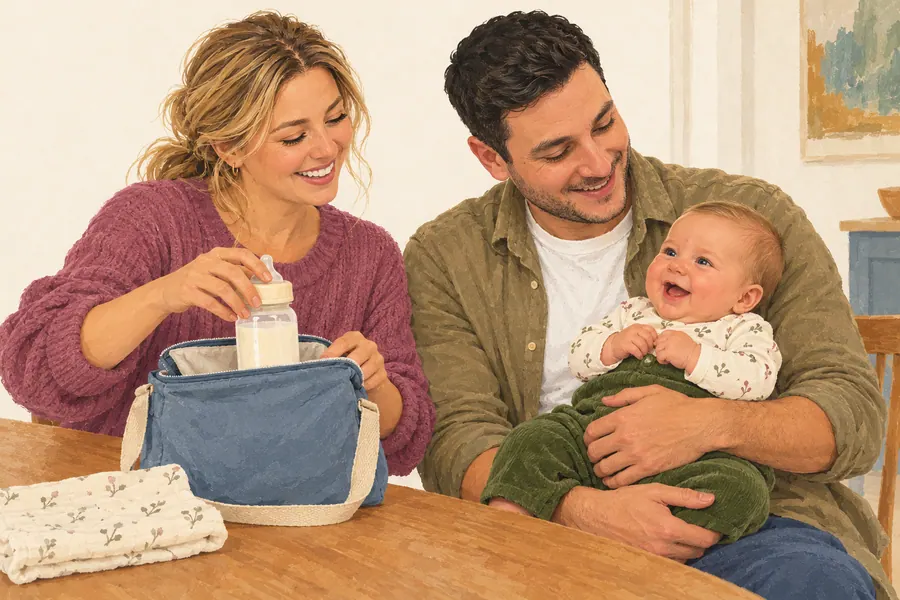
Bottle feeding comes down to three things: clean equipment, the right milk made up safely, and a calm feed where your baby sets the pace. You need a few bottles and teats, a way to wash and sterilise them, and either infant formula or expressed breast milk. Victoria's Better Health Channel in Australia and the NHS both say to sterilise feeding equipment until your baby is 12 months old.
During the feed, hold your baby close and semi-upright, keep the bottle nearly horizontal, let them take breaks and stop when they show they're full. Never prop a bottle or put your baby to bed with one. This guide covers equipment, cleaning, the feed itself, warming, safety rules and moving to a cup. Making up formula has its own guide, preparing formula safely, and amounts are covered in how much formula.
What do you need to start bottle feeding?
- Bottles. The Better Health Channel suggests at least 3 large bottles with leak-proof caps, discs and teats, with smooth insides that are easy to clean. Many families have a few more so a clean one is always ready.
- Teats. Choose a flow that suits your baby's age. The Better Health Channel's test is to hold the bottle upside down: milk should drip out at a constant, steady rate rather than pour.
- A bottle brush and a clean basin or container used only for feeding equipment.
- A way to sterilise, such as a large saucepan, a steam steriliser or a chemical sterilising solution.
- Formula and the scoop that comes with it, or storage containers for expressed breast milk.
You don't need special bottles. The NHS says there's no evidence that one type of teat or bottle is better than any other, and that simple bottles that are easy to wash and sterilise are probably best. The Better Health Channel adds that no teat shape has been proven best and that orthodontic teats are no better than regular ones.
How do you clean and sterilise baby bottles?
Clean first, then sterilise. The Better Health Channel says to wash everything in warm, soapy water with a bottle brush before any sterilising method.
- Wash your hands for 20 seconds before handling feeding items, as the CDC's cleaning guide advises.
- Take everything apart and rinse off milk soon after the feed.
- Wash in hot soapy water with a bottle brush, in a basin used only for feeding items rather than straight in the sink. Squeeze water through the teat holes.
- Rinse under running water.
- Sterilise using one of the methods below.
- Air-dry on a clean towel or rack. The CDC says not to rub or pat items dry with a dish towel.
- Store the dry, reassembled parts somewhere clean and covered.
| Method | What the guidance says |
|---|---|
| Boiling | Cover with water and boil for 5 minutes; Better Health Channel says store in the fridge and re-boil if unused after 24 hours |
| Chemical solution | Follow the product's strength, soak at least 1 hour without rinsing and change the solution every 24 hours (Better Health Channel) |
| Steam (electric or microwave) | Follow the manufacturer's instructions; no metal in a microwave steriliser |
| Dishwasher | The CDC says a hot-water cycle with heated drying doesn't need a separate sanitising step |
How long and how often differs by country. Australian and UK guidance sterilises until 12 months. The CDC asks for sanitising at least daily, or more often, for babies under 2 months, born prematurely or with a weakened immune system, and says older healthy babies may not need daily sanitising if items are carefully cleaned after every use. Follow the advice your own health service gives.
How do you give a bottle feed, step by step?
These steps come from the NHS bottle feeding advice and the CDC's bottle-feeding guide.
- Get comfortable and hold your baby close, in a semi-upright position with their head supported so they can breathe and swallow comfortably.
- Look at your baby and talk to them. The NHS describes feeds as a chance to bond.
- Brush the teat against their lips and let them draw it in when their mouth opens wide.
- Keep the bottle nearly horizontal, just tipped enough to fill the teat, so milk only comes out when your baby sucks.
- Let your baby take breaks when they want them. Give plenty of time to feed.
- Wind your baby partway through and at the end by holding them upright and gently rubbing or patting their back; see burping and wind.
- Stop when they show they're full, even if milk is left. The CDC says not to force your baby to finish the bottle, and the NHS says it's fine if they don't.
Paced bottle feeding goes through this technique in more detail and is especially useful for breastfed babies.
How long should a bottle feed take?
The Better Health Channel suggests a baby should take about 15 to 30 minutes to finish a bottle. A feed that's over in a few minutes may mean the flow is too fast. If the teat flattens during the feed, loosening the cap slightly lets air back in.
Who should give the bottles?
The NHS says babies feel more secure when most feeds are given by you, your partner or their main carer, so try to keep the number of people feeding your baby small at first. If you're breastfeeding, the CDC says your baby may take a bottle more readily from someone other than you, and suggests starting at a calm time when they aren't very hungry or very full. Combination feeding and bottle refusal cover introducing a bottle to a breastfed baby.
Should you warm a baby's bottle?
Warming is optional. The NHS breast milk storage guide says expressed milk can be given straight from the fridge if your baby is happy to drink it cold.
To warm a bottle, the Better Health Channel suggests standing it in hot (not boiling) water for about 10 minutes, then dripping a little onto your wrist; it should feel the same temperature as your skin. If it's too warm, cool it and test again.
Never warm a bottle in a microwave. The Better Health Channel and the NHS warn that microwaves heat unevenly and can create hot spots that burn your baby's mouth. For how long milk keeps once warmed, see storing breast milk and preparing formula safely.
What are the most important bottle-feeding safety rules?
- Never prop the bottle or leave your baby to feed alone. The NHS warns your baby may choke, and the CDC says propping also raises the risk of ear infections, tooth decay and overeating.
- Never put your baby to bed with a bottle. The CDC says milk can pool around the teeth and cause decay, and the Better Health Channel says feeding alone in bed can cause choking.
- Only breast milk or formula in the bottle. The CDC says cereal or other solid food in a bottle won't make a baby sleep longer and can raise the choking risk. The NHS also says not to add sugar, cereal, baby rice or chocolate powder.
- Don't keep leftovers. The NHS says to throw away any formula or breast milk left in the bottle after a feed.
- Make formula exactly as the label says. Extra or fewer scoops can make your baby unwell; see preparing formula safely.
When should babies stop using a bottle?
The NHS guide to drinks and cups suggests introducing a cup or beaker from around 6 months. It says an open cup or a free-flow cup without a valve helps your baby learn to sip and is better for their teeth.
Once your baby is 1 year old, the NHS says bottles should be discouraged. Drinks flow slowly through a teat, so anything sugary stays in contact with the teeth for longer. Cups and dropping bottles has a step-by-step plan for the switch.
When should you get help?
These signs come from the NHS guide to spotting a seriously ill baby. If your baby chokes and can't breathe, cough or cry, call your local emergency number (000 in Australia, 999 in the UK, 911 in the US) and follow the call-taker's instructions; choking vs gagging explains the first-aid steps, and an infant first-aid course is worth doing before you need it.
Get medical advice the same day (your GP or a health advice line (Pregnancy, Birth and Baby on 1800 882 436 in Australia, NHS 111 in the UK, your pediatrician's after-hours line in the US)) if your baby:
- is refusing feeds or feeding much less than usual
- has fewer wet nappies than usual, which the NHS dehydration page lists as a reason for urgent advice
- is violently sick, or is sick a lot and seems to be in pain
Mention it to your GP or child-health nurse if feeds often take much longer than 30 minutes, your baby often coughs or splutters during feeds, you're worried about their growth or appetite, or you're thinking of changing formula because your baby seems unsettled. The Better Health Channel suggests getting advice before switching formulas.
What's worth noting about bottle feeds?
A quick note of the time, how much was in the bottle and how much was left shows what your baby actually drank, which is more useful than what was made up. If several people give bottles, a shared note of the teat, the warming method and how your baby showed they were full keeps feeds consistent. If anything worries you, a few days of these notes helps your GP or child-health nurse see the pattern.