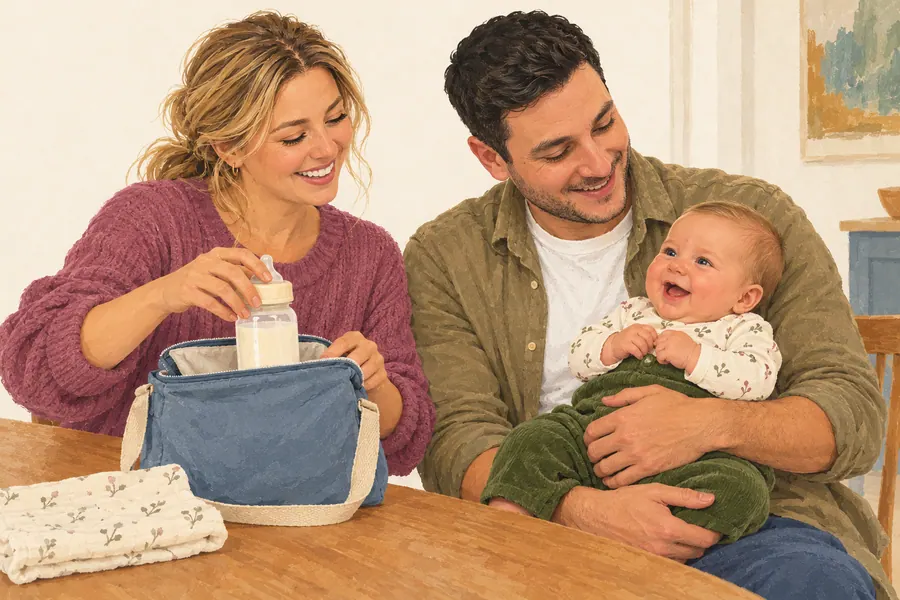
A useful milk stash is usually much smaller than the overflowing freezers you see online. What you need is enough expressed milk for the feeds your baby will have while you're apart, plus a small buffer. The Australian Breastfeeding Association's guide to milk stashes says that if you express while at work, the milk you express one day is often enough for the next, so a large store usually isn't needed.
To work out your number, multiply the feeds while you're apart by the amount your baby takes per feed. Build it by expressing a little each day, store it in small portions, label it, and use the oldest first. This guide walks through the calculation, when to start, how to freeze and organise milk, and the exact thawing rules, which are easy to get wrong.
Do you actually need a milk stash?
It depends on your plans. The Australian Breastfeeding Association says you may not need one at all if you're only away for a few hours: you can feed just before you leave and when you get back, go out while your baby sleeps, or have your baby brought to you.
You're more likely to want some stored milk if:
- you're going back to work or study and your baby will have bottles of breast milk
- you'll be away for a full day or overnight
- you want a small back-up for appointments or illness
Babies over 12 months can have food and water while you're apart, and the Australian Breastfeeding Association notes they often catch up on breastfeeds when you're together. Some families also choose to combine stored milk with formula; see combination feeding.
How much breast milk do you need to store?
Use a simple calculation rather than a target from social media.
- Count the feeds while you're apart. For example, a baby who feeds about every 3 hours will usually have 2 or 3 feeds across an 8-hour absence.
- Estimate the amount per feed. If your baby already takes bottles, use their usual amount. If not, the Australian Breastfeeding Association's expressing basics says babies aged 1 to 6 months drink an average of about 750 mL of breast milk a day. Divide that by the number of feeds in 24 hours: with 10 feeds, that's about 75 mL per feed. From 6 to 12 months the average is around 600 mL a day.
- Multiply, then add one or two small spare portions in case of a longer day or a spill.
| Example (fictional) | Your numbers |
|---|---|
| Feeds while apart | 3 |
| Amount per feed | 75 mL |
| Milk for one day apart | 225 mL |
| Plus 2 spare portions of 50 mL | About 325 mL |
If you'll express at work, that one-day figure (plus spares) may be all you need before you start, because what you express each day covers the next. If you won't express while apart, you'll need that amount for every day away. Averages vary a lot between babies, so adjust once you see how much your baby actually takes.
When should you start building a stash, and how?
There's no fixed start date. In the first 6 weeks, the Australian Breastfeeding Association says breastfeeding or expressing at least 8 times in 24 hours helps build and protect your supply, so focus on feeding first. If breastfeeding is going well, work backwards from the day you need the milk: divide the amount you need by what you can comfortably add each day.
To build it gently:
- Express a little each day rather than whole feeds. The Australian Breastfeeding Association says even 20 mL a day adds up.
- Pick a time that suits you, such as after a feed or between feeds when there's a longer gap.
- Don't overdo it. The Australian Breastfeeding Association warns that expressing much more than you need can lead to oversupply and breast inflammation.
For pump choice, flange fit and getting more milk per session, see pumping basics.
How long can you store breast milk in the fridge and freezer?
Storage times for freshly expressed milk differ between countries, so follow the guidance for where you live. These match our breast milk storage guide.
| Where | Australia (ABA) | UK (NHS) | US (CDC) |
|---|---|---|---|
| Fridge | 72 h at 5°C or colder | Up to 8 days at 4°C or lower | Up to 4 days |
| Freezer in the fridge | 2 weeks | 2 weeks (ice compartment) | Not given |
| Separate-door freezer | 3 months at -18°C | Up to 6 months at -18°C | About 6 months best, up to 12 acceptable (any freezer) |
| Deep freezer | 6–12 months at -20°C | Not given | As above |
The Australian Breastfeeding Association's storage table gives the fridge time as 72 hours, stored at the back where it's coldest. The NHS guide to storing breast milk says to use milk within 3 days if your fridge runs between 5°C and 10°C. The CDC's storage guide says to freeze milk straight away if you won't use it within 4 days, and notes that quality falls over time even when frozen milk is safe.
How should you organise a freezer stash?
- Use the right containers. Breast milk storage bags or clean, food-grade containers with tight lids. The CDC says not to use disposable bottle liners or bags not meant for breast milk.
- Freeze small portions. The Australian Breastfeeding Association suggests 50 to 100 mL; the CDC suggests 60 to 120 mL (2 to 4 oz) or one feed's worth.
- Leave room to expand. Fill containers no more than three-quarters full (ABA), or leave about 2.5 cm (1 inch) at the top (CDC).
- Label every portion with the date you expressed it. For childcare, the CDC says add your child's name and ask about the centre's labelling rules.
- Store at the back of the freezer, not in the door, where temperatures change less.
- First in, first out. The CDC says always thaw the oldest milk first.
Freezing bags flat and keeping them in date order (for example, a box per week) makes the oldest milk easy to find. If the power goes out, the Australian Breastfeeding Association says milk that still has ice crystals can be refrozen; fully thawed milk should be thrown away.
How do you thaw frozen breast milk safely?
The time limit after thawing depends on how it was thawed. The "24 hours" rule only applies to milk thawed in the fridge.
| Situation | Australia (ABA) | US (CDC) | UK (NHS) |
|---|---|---|---|
| Thawed in the fridge, not warmed | Keep in the fridge up to 24 h | Use within 24 h of fully thawing | Use straight away |
| Thawed in warm water or warmed | Use for that feed, then discard | Use within 2 h | Use straight away |
| Refreezing thawed milk | No | No | No |
| Left after a feed | Discard | Discard after 2 h | Discard 1 h after the feed starts |
To thaw, the CDC suggests the fridge overnight, a bowl of warm water, or lukewarm running water. Never use a microwave, which the CDC says can create hot spots that burn a baby's mouth. Swirl the milk to mix the fat back in and test it on your wrist. Milk can be given cold or at room temperature if your baby accepts it.
Plan ahead by moving tomorrow's portions from the freezer to the fridge the night before, so you can use the fridge-thawed rule. For giving the bottle, see paced bottle feeding.
When should you get help?
Talk to a lactation consultant or a breastfeeding helpline (the Australian Breastfeeding Association on 1800 686 268 in Australia, the National Breastfeeding Helpline on 0300 100 0212 in the UK) if expressing is painful, your supply seems to be dropping, or you can't express as much as your baby takes while you're apart. Ask your baby's hospital team about storage if your baby is premature or unwell; the Australian Breastfeeding Association says they may need extra precautions. If your baby has fewer wet nappies or seems unwell, see the urgent signs in is my baby getting enough breast milk?.
What's worth noting about your stash?
A short list of what's in the freezer (date expressed and amount) next to what your baby actually drinks each day apart shows whether your stash is growing, shrinking or steady. After a week or two back at work, that comparison tells you whether you need to add a pumping session or can relax about it.